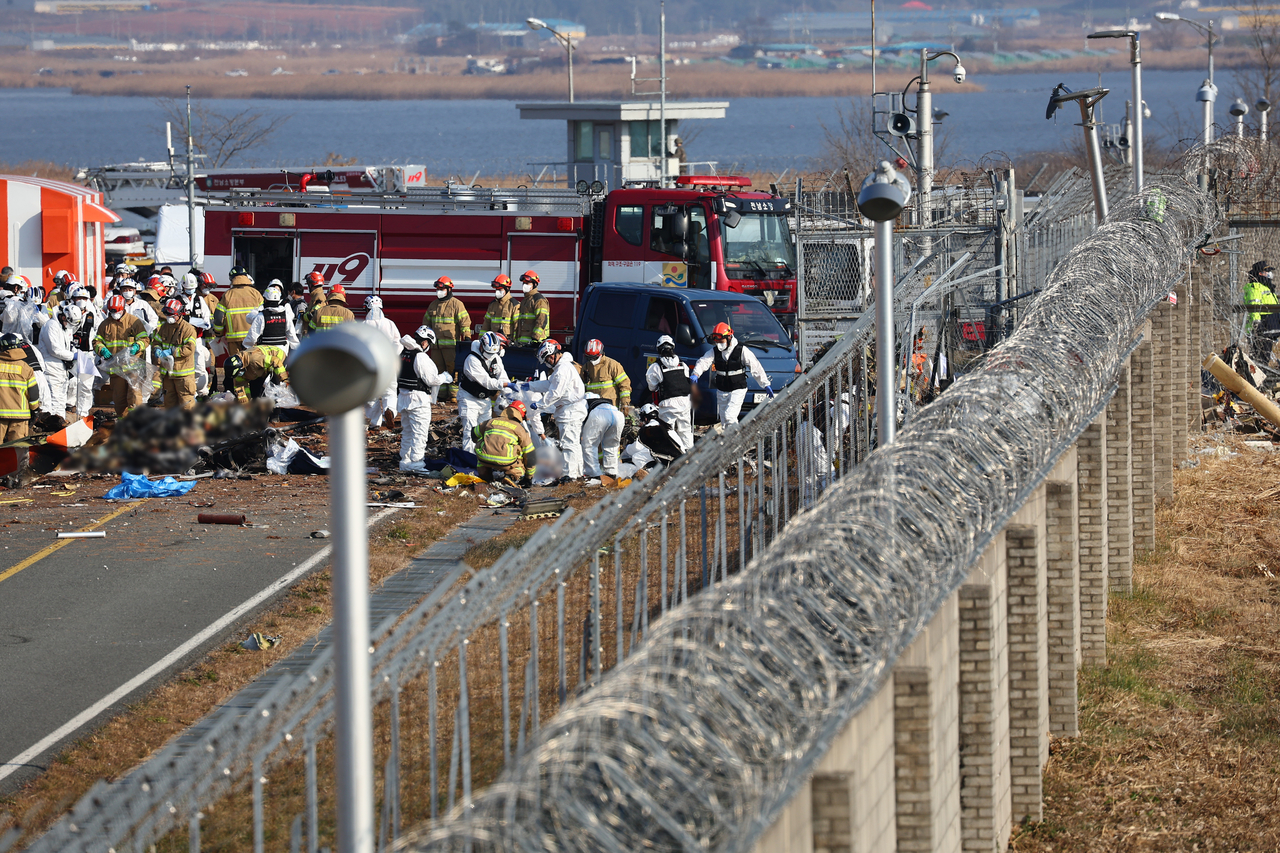
A rare concrete wall at the end of the runway of Muan International Airport is suspected to have exacerbated damage to the Jeju Air flight that crash-landed Sunday and claimed 179 lives.
The Boeing 737-800 airplane, departing from Bangkok, attempted a belly landing in the morning at the airport, apparently after suffering multiple malfunctions concerning its engines and landing gear.
The plane skidded and collided with the nearly 2-meter-tall concrete wall supporting several “localizers,” metal antennas that provide directional signals to align aircraft with the runway, and then the perimeter fence to burst into flames. Out of the 181 passengers and crew, just two survived.
While investigations have just started to look into the exact cause of the crash, experts say there should be no concrete wall at the end of an airport runway.
According to local authorities, other airports also have concrete structures for localizers, but they are shorter. Incheon Airport has its localizers mounted at less than 7.5 centimeters above the ground, while Gimpo International Airport in Seoul has localizers installed directly at ground level. The localizers are made of metal beams and designed to break apart upon impact.
In 2016, a UPS cargo plane crashed into localizers at Incheon Airport, but all five crew members were able to safely evacuate the plane afterward.
“We found no safety violations,” a Land Ministry official said of the concrete wall in Muan during a briefing on Monday. The official said the ministry plans to inspect the safety of other concrete mounds at other provincial airports.
In the meantime, the official also denied any operational negligence in responding to the fatal accident. Questions were raised as to why a foam path was not applied to the runway to reduce the landing shock of the plane during Sunday’s accident.
“When it comes to a belly landing, a foam path can accelerate sliding. So the guideline is not applied to this case,” the official said.
forestjs@heraldcorp.com