[THE INVESTOR] Korea needs to accelerate industrial restructuring and deregulation as its growth potential continues to weaken, economists here say.
According to the Ministry of Strategy and Finance, the Korean economy grew by 0.5 percent from a year earlier in the first quarter of this year and fiscal spending made a 0.5 percent contribution to quarterly growth. This means that Asia’s fourth-largest economy would have barely grown in the cited period without measures to expand fiscal expenditure.
The government front-loaded 60 percent of the 2016 budget in the first half of the year to prop up the slumping economy as consumer spending and corporate investment continued to remain sluggish.
Announcing economic policy directions for the second half of the year last week, policymakers forecast the Korean economy will expand by 2.8 percent in 2016, on the conditions that a supplementary budget worth 10 trillion won ($8.58 billion) and other fiscal stimulus measures are put into place.
But many economists regard the growth target, which was revised down from the earlier projection of 3.1 percent, as still out of reach.
In a report released a day after the government’s announcement, the Korea Economic Research Institute, a private think tank, predicted the economy would grow by as low as 2.3 percent this year.
The planned supplementary budget would be the third to be drawn up by President Park Geun-hye’s administration, which has front-loaded budgetary spending in the early part of the year since being installed in February 2013.
This repeated pattern of drawing up an extra budget to avoid a fiscal cliff that might be caused by front-loaded fiscal expenditure has led to Korea’s national debt increasing from 489.8 trillion won in 2013 to 645.2 trillion won this year. The ratio of national debt to gross domestic product rose from 34.3 percent to 40.1 percent over the cited period, according to figures from the Finance Ministry.
“An aggressive fiscal input is needed to prevent the economy from being stuck in a low-growth rut,” said a ministry official, asking not to be named.
Most economists agree it is somewhat necessary to strengthen fiscal roles to bolster growth, as domestic demand is slumping and global economic conditions are becoming more volatile in the aftermath of the U.K.’s vote last month to leave the European Union.
They note, however, the habitual reliance on short-term fiscal stimulus unaccompanied by structural reform and deregulation has weakened the country’s economic fundamentals.
“What is urgently needed is to step up efforts to boost the country’s declining growth potential,” said Lee Geun-tae, a researcher at the LG Economic Research Institute.
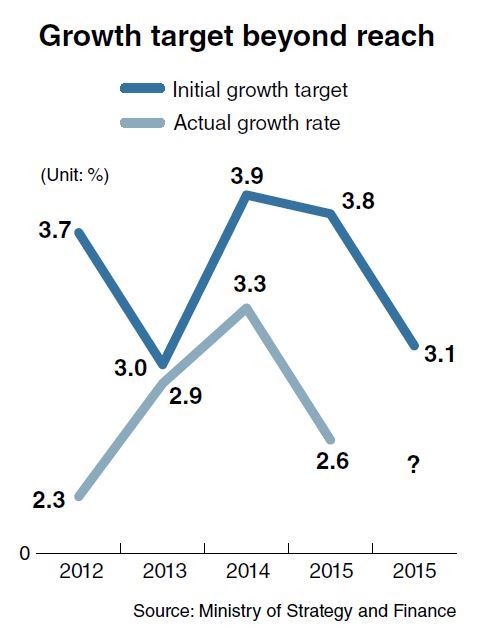
The gap between the government’s growth target and the actual growth rate has been widening in recent years, despite repeated fiscal stimulus, which may be viewed as showing that Korea is losing long-term growth momentum.
The country has seen traditional manufacturing industries, which had driven its economic expansion in the past, making less contributions or even dragging growth.
A report released by the Korea Institute for Industrial Economics and Trade last week showed overseas shipments by Korea’s major industrial sectors, such as steel, shipbuilding and petrochemicals, decreased at a more rapid pace than overall exports. In the first half of this year, exports by such industries fell by 11.8 percent, while overall exports dropped by 10.8 percent.
The steeper fall in exports by the main industrial sectors stems from intensifying competition with emerging economies, particularly China, amid slowing growth in global trade.
According to the report, China is catching up with Korea in most of the major manufacturing sectors. With Korea’s quality competitiveness at 100, comparative figures for China range from 90 to 100 in steel, petrochemicals, textile, consumer electronics, display panels and information and communication devices.
The institute predicted Korea will be able to keep a competitive edge over China in a small number of high-tech products, key materials and parts after five years.
Worsening economic and industrial conditions raise an urgent need for Korea to accelerate efforts to nurture next-generation industries that can ensure the sustainable growth of its economy in the coming decades, experts note.
Lee Sang-geun, a professor of business administration at Sogang University in Seoul, said the country should no longer dwell on its established position in traditional manufacturing sectors and has to focus on areas of industrial convergence, including artificial intelligence, robotics, drones, Internet of Things and virtual reality technology.
“Korea will be left behind in the global tide if it is unable to make a successful push to develop new industries,” he said.
The government has pledged to boost long-term growth potential by matching structural reforms in public, labor, financial and education sectors with industrial renovation.
But critics indicate this pledge has yet to be backed by substantial and concrete support for corporate ventures into new fields that could create more jobs for young talented people.
Drastic deregulation, which has been delayed despite policymakers’ active gestures, should be an essential part of this support, they say.
By Kim Kyung-ho ()











