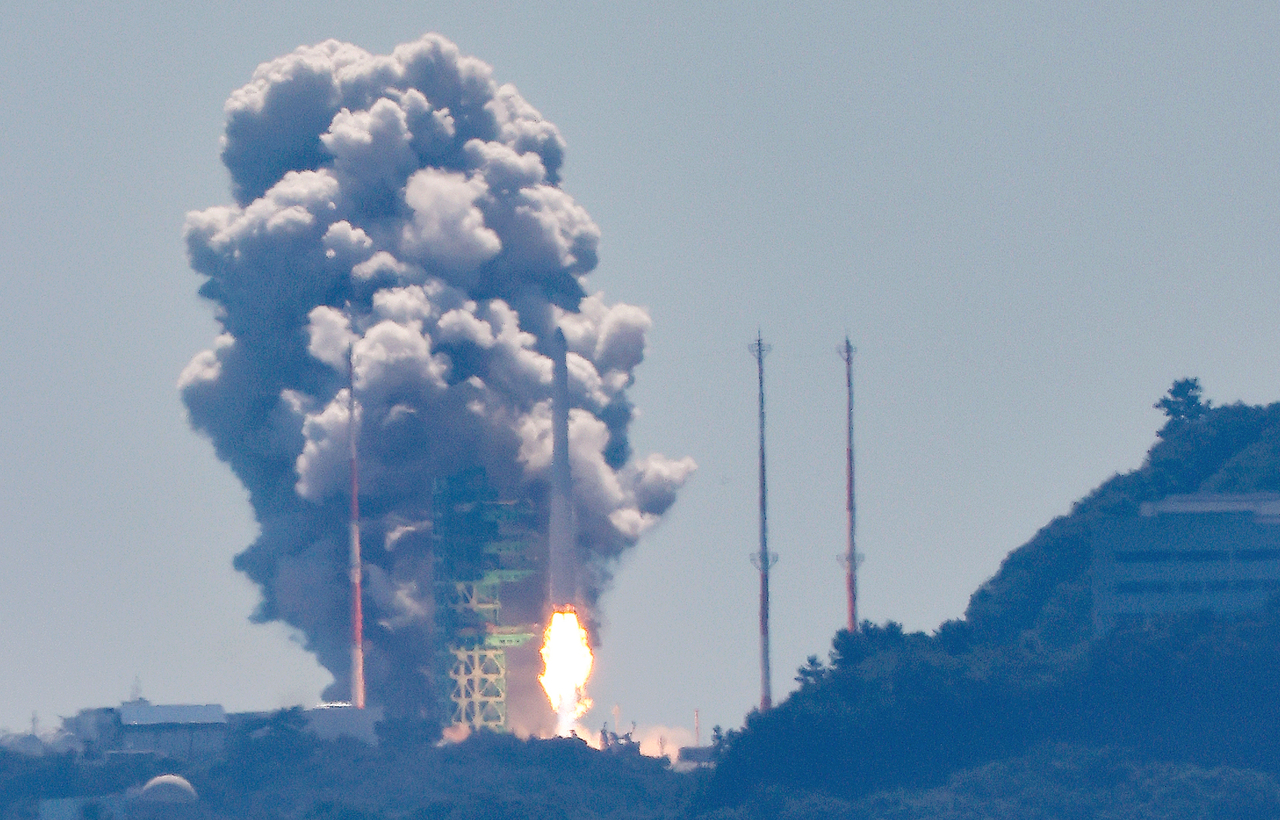
South Korea’s homegrown Nuri rocket lifted off Wednesday on its fifth mission, carrying 15 satellites toward a sun-synchronous orbit about 575 kilometers above Earth.
The three-stage rocket, also known as KSLV-II, blasted off at 12:25 p.m. from the second launch pad at the Naro Space Center in Goheung, South Jeolla Province.
On its way to the target orbit, Nuri is to separate its first stage, payload fairing and second stage in sequence before deploying the satellites.
The rocket is carrying five microsatellites as its primary payload, along with 10 CubeSats.
The five microsatellites will operate as a constellation designed to provide high-resolution observations of the Korean Peninsula. The CubeSats will carry out experiments involving pharmaceuticals and industrial components in space, while also studying space radiation and Earth’s magnetic field.
Launch preparations began early Wednesday, with checks on Nuri’s propellant supply system completed at around 7:50 a.m. Fuel and oxidizer loading was completed at around 11:06 a.m., followed by the withdrawal of the rocket’s support structure at around 11:55 a.m.
Nuri switched to its automated launch sequence at 12:15 p.m., 10 minutes before liftoff.
The launch operation is expected to continue until around 1 p.m. Authorities are expected to announce the outcome of the mission at around 2 p.m., after checking the deployment and initial communications of the satellites.
yeeun@heraldcorp.com



![[Graphic News] Nuri rocket set for fifth launch](https://wimg.heraldcorp.com/news/cms/2026/10/06/news-p.v1.20261005.74d188bdaff2417ebabf4560181741f4_T1.gif?type=h&h=800)