1 dead, 4 injured as landslides, rains hit Busan, Ulsan, South Gyeongsang
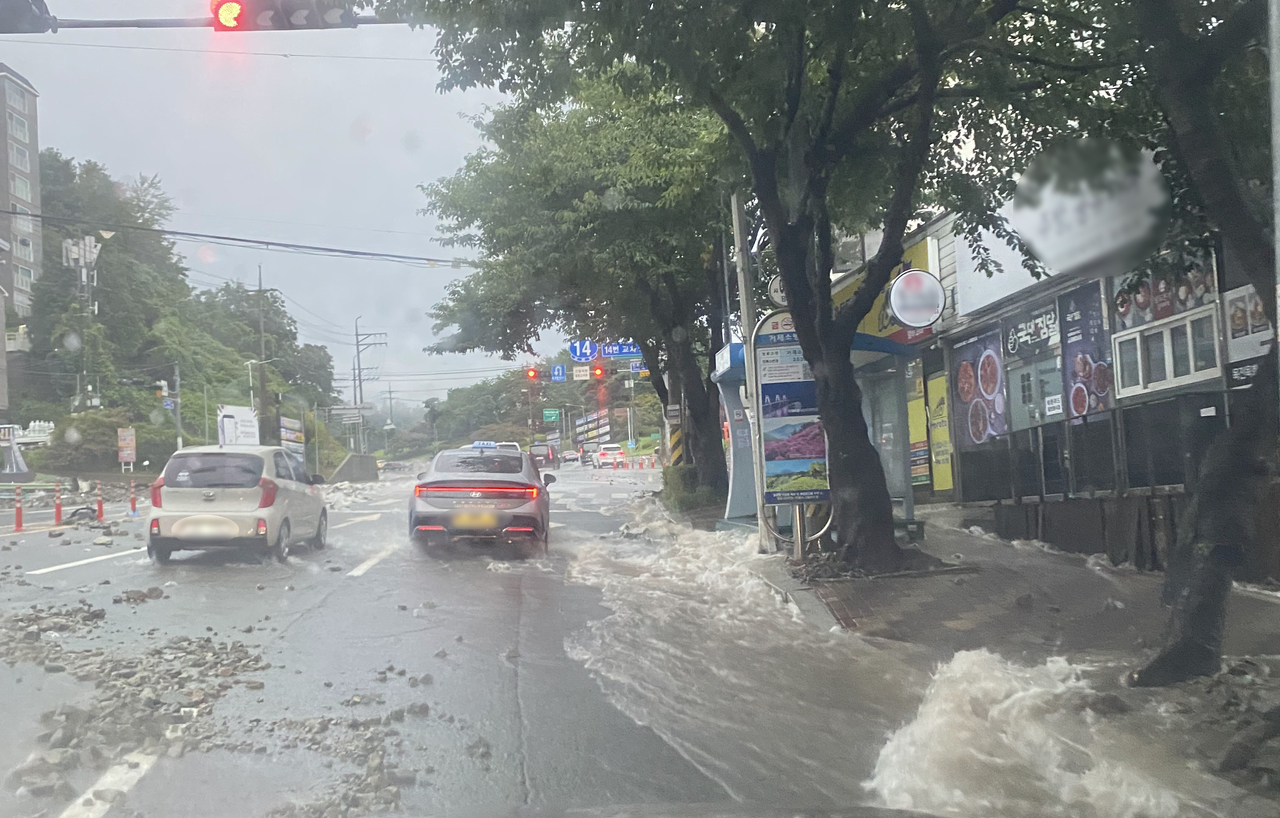
Torrential rain topping 800 millimeters battered southeastern Korea through Monday, triggering floods and landslides after weeks of drought.
At least one person was killed, four others were injured and nearly 160 residents were evacuated as torrential rain and strong winds inundated roads and triggered landslides across the region.
According to the Korea Meteorological Administration, in South Gyeongsang Province, Geoje received 851.1 millimeters of rain from midnight Saturday through 1 p.m. Monday, while nearby Tongyeong recorded 704.8 mm and Sacheon received 380.5 mm. Meanwhile 441 mm fell on Gadeokdo in Busan.
Geoje recorded 124.5 mm of rain in a single hour from 1:32 a.m., the highest hourly rainfall ever recorded there. Tongyeong also set a record with 97.4 mm in one hour from 5:11 a.m.
The three-day cumulative rainfall amounted to roughly 90 percent of the region's average precipitation for the entire June-August period.
Most of the torrential rain had subsided in the affected areas by Monday afternoon, but videos showing damaged roads and homes continued to circulate online, as residents remained shaken by the dramatic shift in weather.
As of 5 p.m. Monday, Geoje, Tongyeong and Goseong, also in South Gyeongsang Province, remained under heavy rain advisories despite the downpour having largely moved out of the region.
Anxiety, disruption grip rain-hit areas
Residents endured a night of repeated emergency alerts as floodwaters rose across low-lying areas, with images and videos of submerged roads and neighborhoods circulating on social media.
"Overnight, I heard the loud emergency alert three times on my phone. Every time I was about to fall asleep, another alert came, warning of heavy rain and advising evacuation," said a Geoje resident in his 50s surnamed Jeong.
"It was still raining heavily this morning, and I heard that low-lying areas were flooded and in chaos."
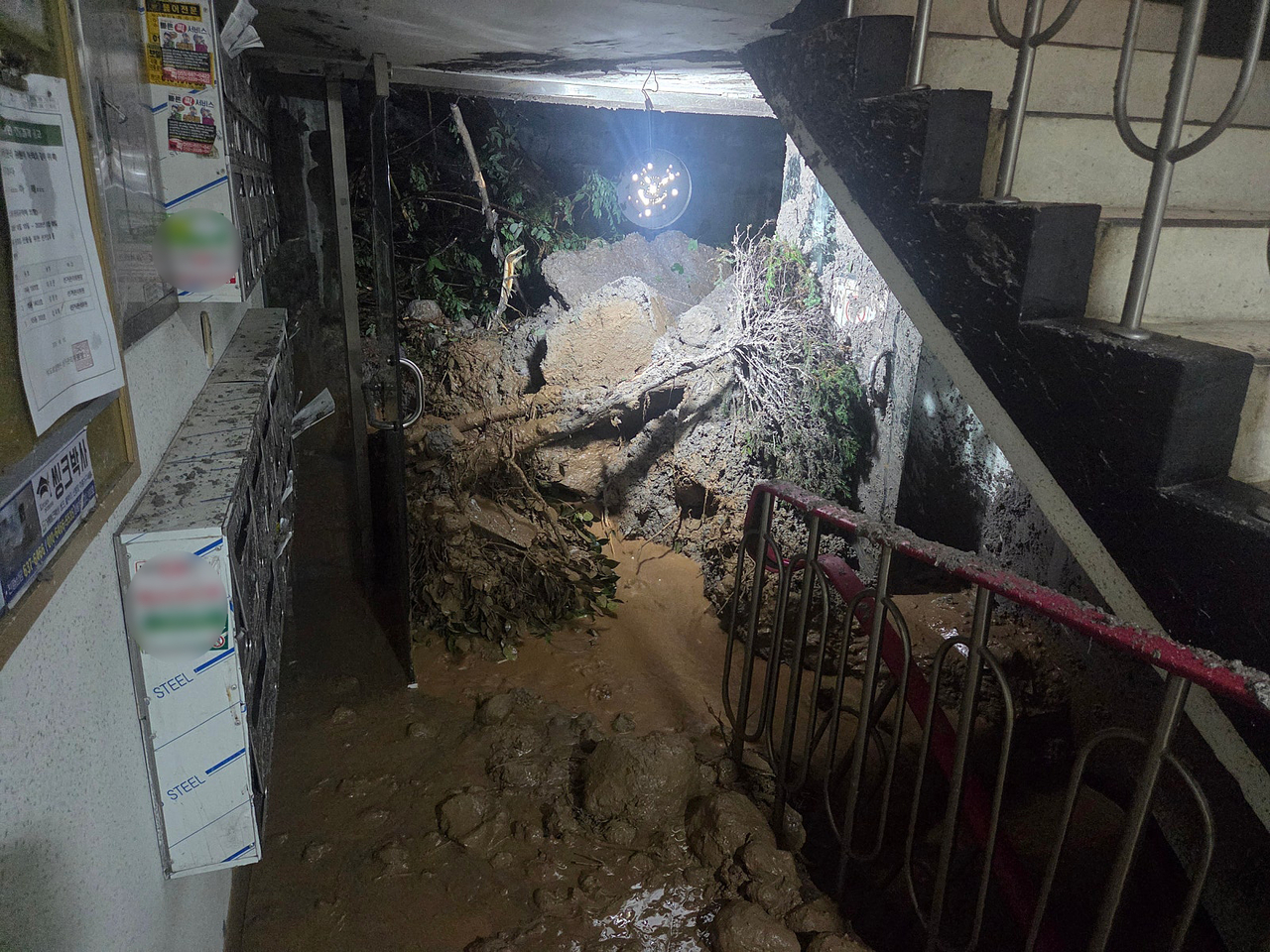
The National Fire Agency said one person was killed and two others suffered minor injuries after a landslide engulfed the first floor of an apartment building in Okpo-dong, Geoje, at around 4:32 a.m.
In Tongyeong, one person was rescued after being buried by a landslide at around 5:05 a.m. Multiple landslides also blocked major roads, including National Route 33 in Goseong.
In Ulsan, one person was injured in a car accident after attempting to avoid a fallen tree.
Flooding in some coastal areas was worsened by high tide.
Public transportation was suspended in parts of Geoje due to flooding and landslides, prompting major local employers including Hanwha Ocean and Samsung Heavy Industries to allow employees to stay home rather than commute to work.
The scale of the disruption was reflected in the volume of emergency calls. In Geoje and Tongyeong alone, authorities had received 1,947 reports related to the heavy rain as of 11 a.m. Monday, while firefighters rescued a total of 136 people.
Prime Minister Han Seong-sook called on police, firefighters and other safety authorities to use all available resources to rescue residents and assist evacuees.
"Please make every effort to provide emergency support so that evacuees face no inconvenience, including by operating temporary shelters," Han said.
The prime minister also instructed officials to maintain emergency preparedness and ensure the safety of rescue workers at disaster sites.
Behind the extreme change
The deluge marks a dramatic reversal for a region that had been struggling with severe drought only days earlier.
From July 1 through Saturday, South Gyeongsang Province received just 141.8 mm of rain, or 19 percent of the average for the period. The prolonged dry spell affected about 5,700 households and roughly 2,100 hectares of farmland, including fields where crops had withered.
Weather authorities attributed the sudden downpour to a combination of factors, including a low-pressure system approaching the Korean Peninsula and an influx of warm, moisture-laden southerly winds.
According to the KMA, the remnants of Typhoon Dolphin moved northeastward, leaving behind a low-pressure system that helped draw large amounts of moisture toward Korea.
As the system approached, a narrow corridor formed between it and a high-pressure system over northeastern Korea, strengthening southerly winds flowing into the country.
Those winds were already carrying abundant moisture after passing over waters off the southern coast where sea surface temperatures were around 27 to 28 degrees Celsius.
When the warm, moist air encountered mountainous terrain along the southern coast and over Jeju Island, it was forced upward, further intensifying rainfall and contributing to record precipitation in some areas, the KMA said.
As of 1:50 p.m. Monday, most of the rain bands had moved out of the country, with only intermittent rain expected in South Gyeongsang Province and Jeju.
forestjs@heraldcorp.com