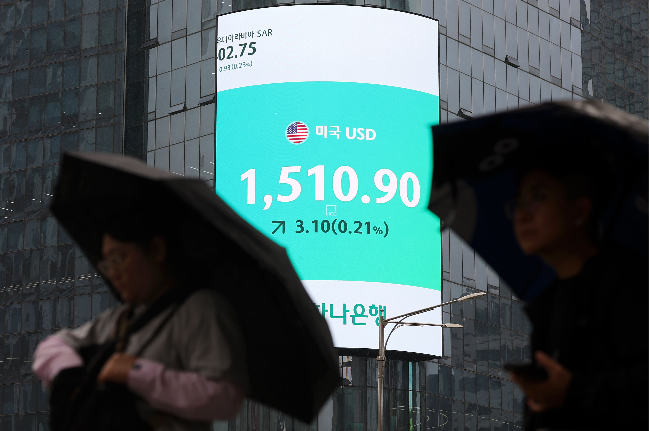
The South Korean won ended stronger after weakening past 1,510 won per dollar in intraday trading Wednesday, hitting a more-than-one-month low amid heavy foreign selling of local equities. Stronger dollar driven by soaring US Treasury yields weighed on the currency as well.
The local currency was quoted at 1,506.8 per dollar as of daytime trading's close, strengthening 1 won from the previous session. During trading, the won breached past the 1,510 threshold, weakening to as much as 1,513.4 per dollar.
It was the first time the currency had weakened past the 1,510 per dollar level since April 6.
The won has shown signs of recovery in recent weeks following volatility triggered by the Iran war. The average monthly won-dollar exchange rate eased to 1,485 in April from 1,492.5 in March.
But the currency is under renewed pressure this month as massive foreign outflows from Korean equities fuel demand for the dollar, as offshore investors convert proceeds from stock sales into dollars.
Foreign investors net sold 38.37 trillion won ($25.6 billion) worth of Kospi shares from May 1 through Wednesday.
On Wednesday alone, they dumped 2.92 trillion won, dragging the benchmark down to close 0.86 percent lower at 7,208.95. During trading, the index plunged to as low as 7,053.84.
A sharp rise in long-term US Treasury yields added downward pressure on the won as well. Overnight, the yield on the 30-year US Treasury bond briefly approached 5.2 percent, its highest level since 2007 before the global financial crisis. The benchmark 10-year Treasury yield also climbed as high as 4.687 percent, the highest since January.
Higher Treasury yields strengthened the dollar broadly. The dollar index, which tracks the greenback against six major currencies, rose to around 99.43 Wednesday morning, its highest level in about a month.
“Although the selloff in US semiconductor stocks has eased, rising long-term Treasury yields continue to pressure emerging-market equities,” said Min Kyung-won, an economist at Woori Bank.
“Heightened uncertainty is also strengthening demand for the dollar even among reserve currencies, meaning emerging-market currencies such as the Korean won are inevitably facing greater pressure,” he said.
silverstar@heraldcorp.com