South Korean President Lee Jae Myung and Japanese Prime Minister Sanae Takaichi met Tuesday in Lee’s hometown of Andong, opening a summit that carried symbolic weight while taking on new urgency over energy security and supply chain resilience.
The hometown setting was rooted in personal diplomacy: Lee had invited Takaichi to Andong during his visit to her home region of Nara Prefecture in mid-January, before the US-Israel strikes on Iran began on Feb. 28.
Four months later, Takaichi’s two-day visit marked the first reciprocal exchange of hometown visits between sitting South Korean and Japanese leaders — a symbolic gesture between neighbors whose ties have long been strained by historical disputes stemming from Japan’s 1910-45 colonial rule of Korea.
But the summit also came at a moment of heightened strategic pressure. The Iran war has disrupted the Strait of Hormuz, a critical oil route, raising pressure on South Korea and Japan — two of the world’s most energy-import-dependent major economies — to deepen cooperation on crude supplies, critical minerals and strategic industries.
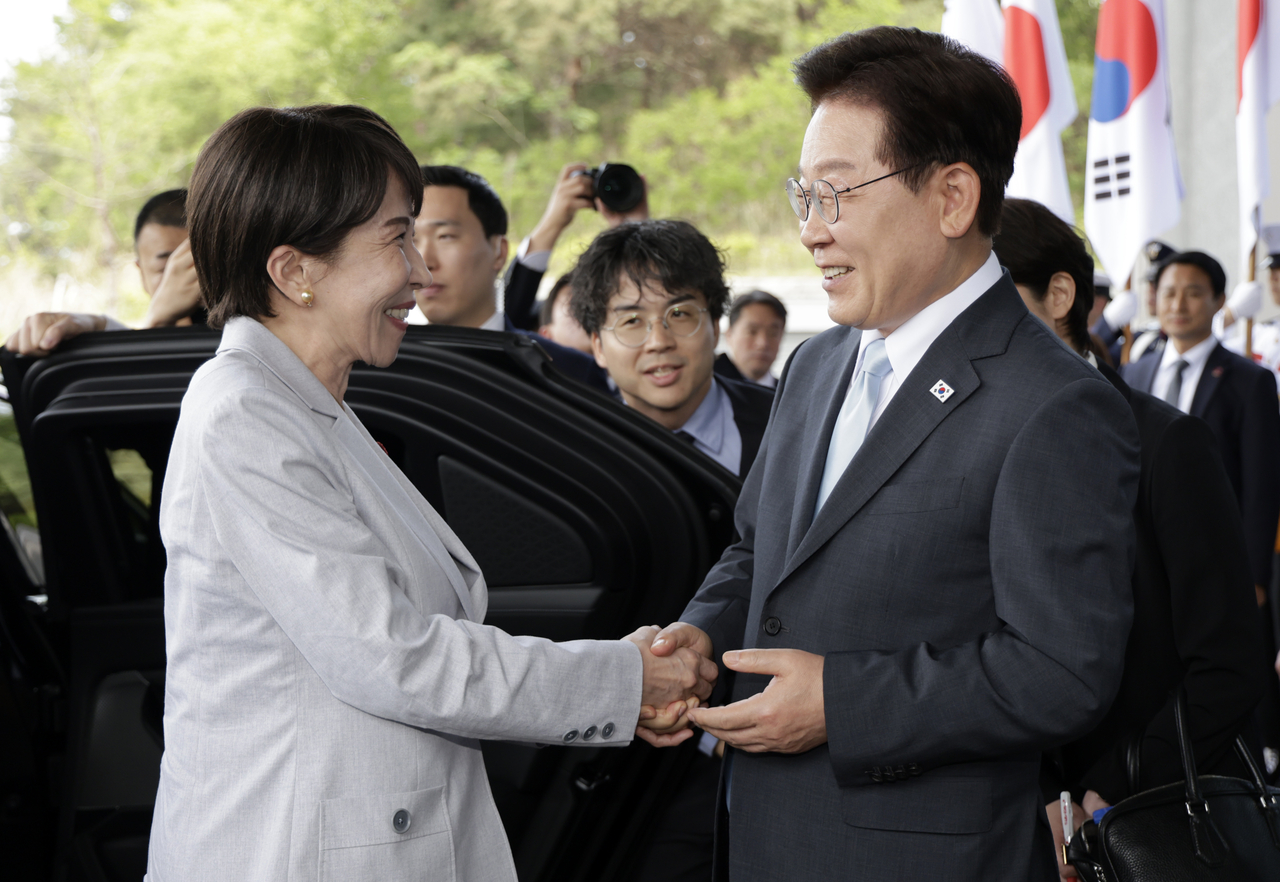
The summit opened with Lee personally greeting Takaichi at the entrance to the venue. Twelve honor guards, six on each side of the hotel entrance, stood in formation in navy, white and green uniforms.
A traditional honor guard consisting of 43 ceremonial guards and a 29-member military band escorted Takaichi’s motorcade — protocol arrangements, Cheong Wa Dae said, comparable to those for a state visit.
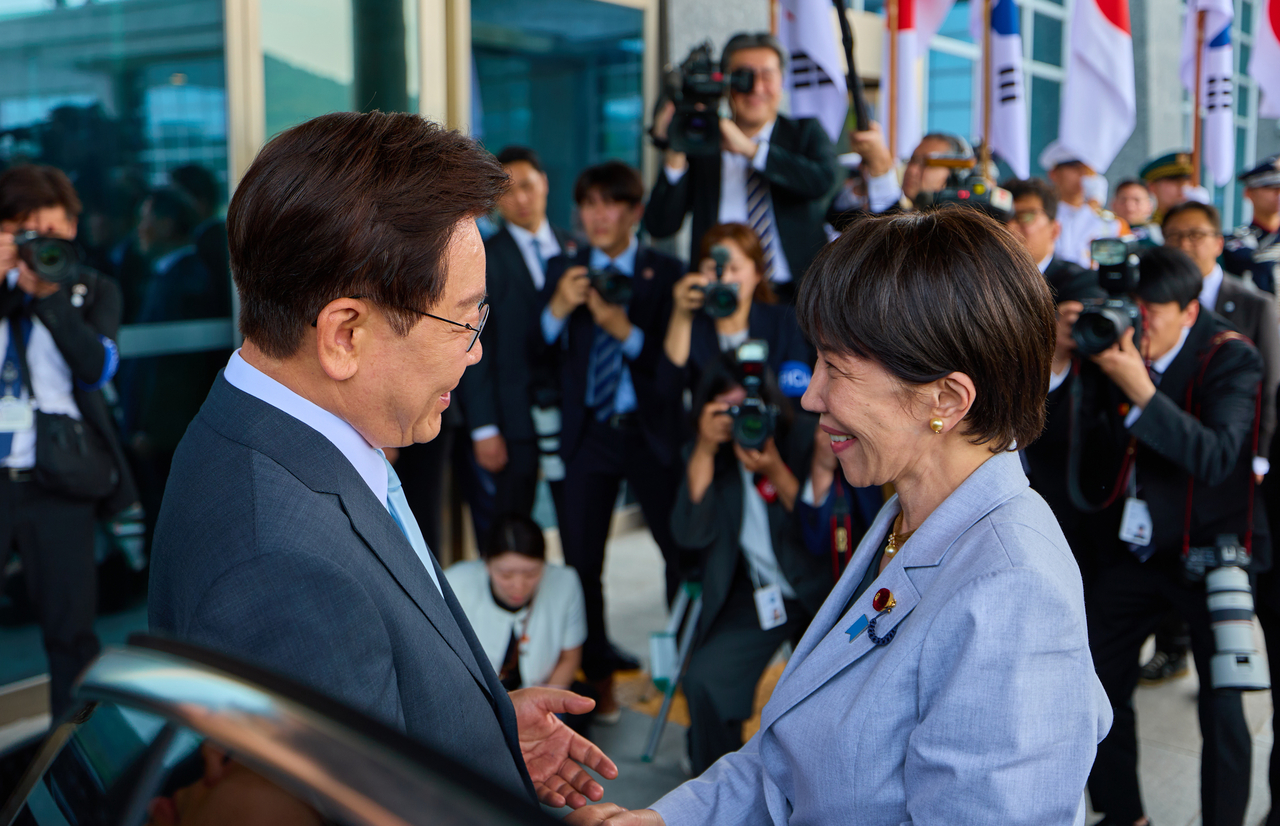
As the rear door of Takaichi’s black vehicle opened, Lee — wearing a sky-blue necktie, a color often favored by Takaichi at official events — clapped and stepped forward. The two leaders shook hands and embraced.
“You must have had quite a journey coming all the way to this small countryside town,” Lee told Takaichi, adding, “I have been waiting for you since last night.”
The summit schedule included a closed-door small-group meeting attended by key aides, an expanded meeting, a joint press conference and a banquet. Separate friendship-oriented events following the banquet underscored the growing personal rapport between the two leaders.
Lee and Takaichi were expected to discuss a broader range of economic security issues, including resilient supply chains for critical minerals and stronger cooperation in energy, trade and strategic industries.
Cheong Wa Dae said the summit would include “broad discussions on the future direction of Korea-Japan relations” and seek to expand “substantive cooperation across various areas directly tied to people’s livelihoods, including the economy, society and public protection.”
The two leaders were also expected to discuss regional and global issues, including the conflict in the Middle East, according to Cheong Wa Dae.
Energy security was anticipated to be one of the summit’s most tangible outcomes.
Seoul and Tokyo were expected to announce bilateral energy security cooperation measures following the summit, Japanese media, including the Yomiuri Shimbun daily newspaper, reported Tuesday.
The measures would focus on creating public-private dialogue channels to facilitate the mutual emergency sharing of crude oil and petroleum products, including jet fuel, in the event of supply disruptions.
The envisioned energy cooperation reflects the shared vulnerabilities of South Korea and Japan: both countries maintain strong petrochemical and refining industries but rely heavily on Middle East crude imports.
The dialogue would also cover efforts to avoid unnecessary export restrictions on petroleum products, and cooperation in crude oil procurement and transportation.
According to data from the Korea Petroleum Association, Japan was South Korea’s third-largest destination for petroleum-product exports last year, accounting for 11.3 percent. Australia ranked first at 16.8 percent, followed by Singapore at 13.6 percent, the US at 10.2 percent and China at 9.2 percent.
The public-private dialogue would also aim to strengthen supply-chain resilience and mutual support in liquefied natural gas, reflecting the two countries’ positions as major global importers.
Japan and South Korea ranked as the world’s second- and third-largest LNG importers in 2024, accounting for 16.47 percent and 11.43 percent of global LNG imports, respectively, according to the International Gas Union's report in 2025.
In addition, the two sides were expected to launch a new “Industrial and Trade Policy Dialogue” between South Korea’s Ministry of Trade, Industry and Resources and Japan’s Ministry of Economy, Trade and Industry to flesh out cooperation in energy and supply chains, according to the newspaper and other Japanese media.
Lee and Takaichi were also expected to discuss possible Korea-Japan cooperation under Japan’s “POWERR Asia” initiative — short for Partnership on Wide Energy and Resources Resilience, according to Japanese media, including Nikkei.
Takaichi unveiled the initiative for Southeast Asian nations at the virtual Asia Zero-Emission Community Plus virtual summit in April, where South Korean Prime Minister Kim Min-seok attended the summit on behalf of Seoul.
At the virtual summit, Takaichi proposed cooperation with Southeast Asian countries to build and jointly use petroleum storage tanks, with plans to provide $10 billion in financial support, including loans and credit assistance through institutions such as the Japan Bank for International Cooperation.
dagyumji@heraldcorp.com