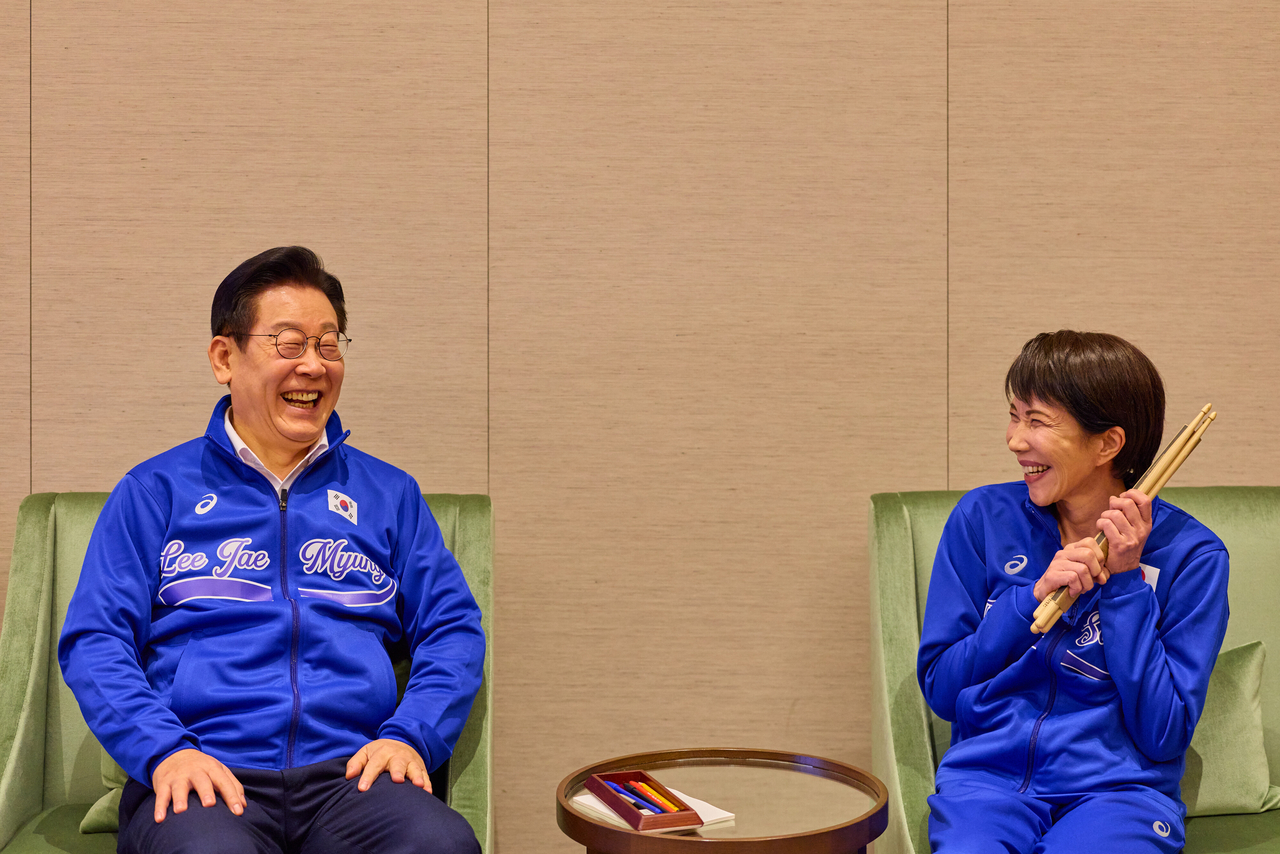
South Korean President Lee Jae Myung and Japanese Prime Minister Sanae Takaichi are set to meet in Lee’s hometown next week to “strengthen substantive cooperation” across a broad range of areas, according to Cheong Wa Dae.
Takaichi will visit Andong in North Gyeongsang Province, where Lee was born and lived until elementary school, from next Tuesday to Wednesday at Lee’s invitation, senior presidential spokesperson Kang Yu-jung announced Friday.
Lee and Takaichi will take part in a series of engagements Tuesday, including one-on-one and expanded summit talks, a joint press conference and a banquet. The two leaders are also expected to share a separate private fellowship program the following day.
“At this summit, the two leaders will hold broad discussions on the future direction of Korea-Japan relations and seek to strengthen substantive cooperation across various areas directly tied to people’s livelihoods, including the economy, society and public protection,” Kang said in a statement.
“They will also discuss regional and global issues, including the situation in the Middle East.”
Notably, Cheong Wa Dae did not refer to long-standing historical disputes stemming from Japan’s colonial rule over the Korean Peninsula from 1910 to 1945 — including issues involving compensation for forced labor and wartime sexual slavery — as key agenda items for the summit.
What to discuss
The Lee-Takaichi summit comes at a sensitive time, following the high-stakes summit between US President Donald Trump and Chinese President Xi Jinping on Thursday and Friday in Beijing, as well as the grinding war in Iran, as Washington and Tehran remain at odds over the terms for ending the war.
Both leaders are expected to discuss alternative supply routes that bypass the Strait of Hormuz and broader energy supply security.
South Korea and Japan face growing energy security challenges from their heavy reliance on Middle East-produced crude oil and related products, following the outbreak of the US-Israel war against Iran on Feb. 28.
According to Cheong Wa Dae, South Korea relied on the Strait of Hormuz for 61 percent of its crude oil imports and 54 percent of its naphtha imports last year. Japan imported more than 95 percent of its crude oil from the Middle East in fiscal 2024, with the United Arab Emirates and Saudi Arabia each accounting for about 40 percent of its total imports, according to data provided by Japan’s Agency for Natural Resources and Energy.
The safety of their vessels stranded by Iran’s blockade and potential participation in international efforts to ensure freedom of navigation through the strait are also expected to be on the summit agenda.
Whether the leaders will discuss Japan’s reported interest in forging an Acquisition and Cross-Servicing Agreement with South Korea during the summit is also drawing attention.
An ACSA is a military logistics support pact that allows the armed forces of the countries to exchange logistical support, supplies, and services during combined exercises, deployments or unforeseen crises.
In early May, the Yomiuri Shimbun reported that Japan aims to make progress in future talks with South Korea on an ACSA, following the inaugural two-plus-two security meeting of their vice foreign and defense ministers in Seoul on May 7. The dialogue had been upgraded from the director-general level.
South Korea’s Defense Ministry has maintained that it is not considering signing a bilateral military logistics support agreement with Japan.
Attention is also focused on whether Seoul and Tokyo can narrow their differences over South Korea’s interest in joining the Comprehensive and Progressive Agreement for Trans-Pacific Partnership, and Japan’s demand that Seoul lift its import restrictions on seafood from Fukushima and seven other Japanese prefectures.
Led by Japan, the CPTPP brings together 12 economies across the Indo-Pacific region, and any new entrant requires unanimous approval from existing members.
Against that backdrop, Japan has called on Seoul to lift the import restrictions introduced in 2013 after the Fukushima nuclear disaster. The restrictions remain in place, with Seoul insisting they will not be lifted until public safety concerns are fully addressed.
Hometown shuttle diplomacy
Cheong Wa Dae underscored the significance of the third summit between Lee and Takaichi taking place outside the capitals of both countries.
The trip comes about four months after Lee traveled to Takaichi’s hometown in Nara Prefecture. During that visit, Lee expressed his intention to invite Takaichi to Andong.
“With Prime Minister Takaichi reciprocating through her visit to Andong, Korea and Japan have realized the first-ever exchange of hometown visits between their leaders,” Kang said.
Lee and Takaichi first held summit talks on Oct. 30, 2025, on the sidelines of the APEC summit in Gyeongju, North Gyeongsang Province. The two leaders then held a brief meeting during the Group of 20 summit in South Africa in November.
“Shuttle diplomacy with Prime Minister Takaichi expands its stage from Gyeongju to Nara, and now Andong is extending beyond the capitals into regional cities,” Kang said.
Shuttle diplomacy between South Korea and Japan refers to the practice in which the two countries’ leaders regularly alternate visits for summit meetings aimed at building trust, swiftly resolving disputes and deepening strategic cooperation.
“We expect it to serve as an opportunity to deepen the strong bond and trust between the two leaders and further solidify the foundation for the future-oriented development of Korea-Japan relations.”
dagyumji@heraldcorp.com