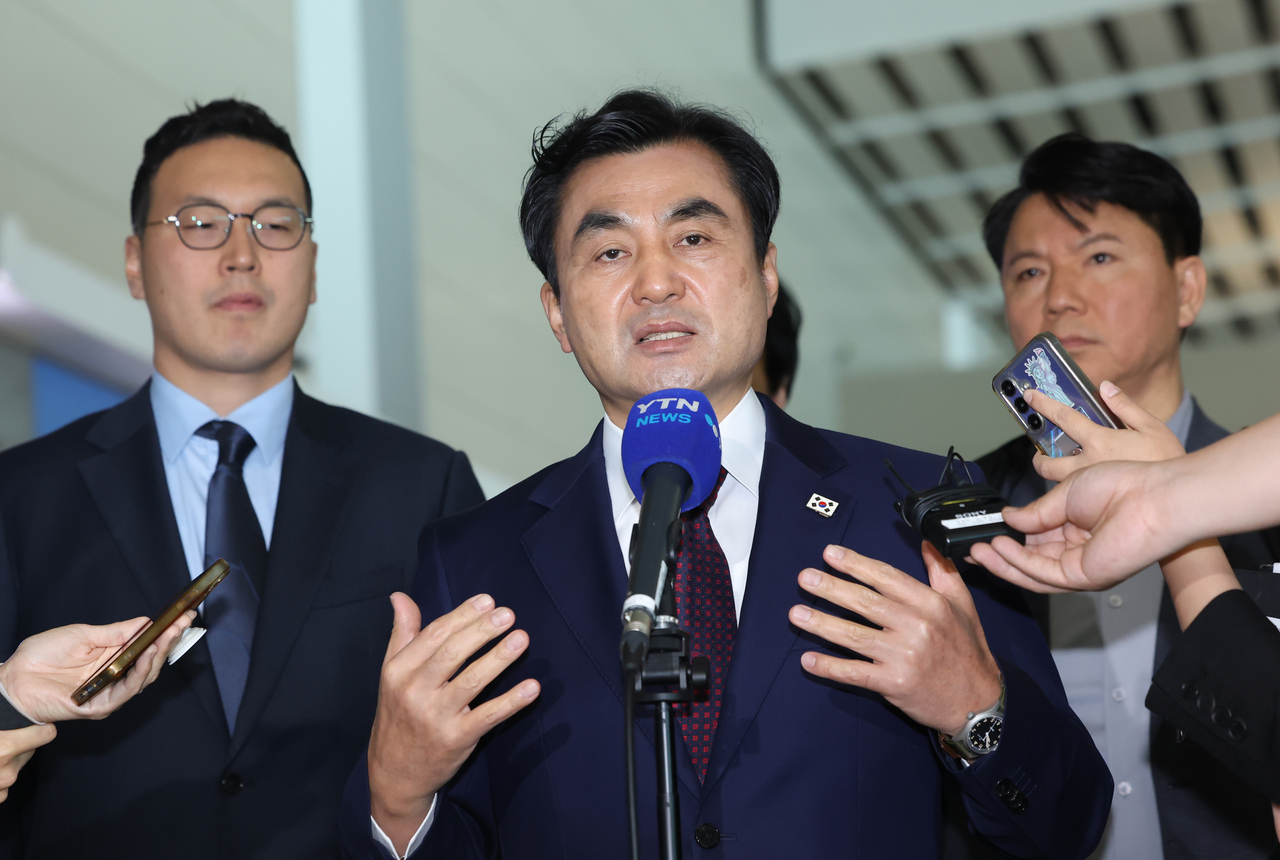
South Korean Defense Minister Ahn Gyu-back departed for Washington on Sunday for apparent high-stakes talks with senior US defense and congressional officials, as Seoul and Washington seek to manage widening differences over the timing of the wartime operational control transfer and stalled negotiations on South Korea’s nuclear-powered submarine ambitions.
Ahn is scheduled to hold talks Monday with US Defense Secretary Pete Hegseth in Washington. Observers expect a broad discussion regarding pending alliance issues, ranging from wartime operational control, or OPCON, transfer to shipbuilding cooperation and Middle East security.
The visit comes amid signs of growing friction between the allies across several areas of security cooperation, despite both governments publicly emphasizing the strength of the alliance.
Speaking to reporters before departing from Incheon Airport, Ahn said there would be “no major issue” in accelerating the wartime OPCON transfer, arguing that Seoul and Washington had already made substantial progress under the allies’ conditions-based roadmap.
“South Korean and US officials made significant progress in 2015 regarding the wartime OPCON transfer under a conditions-based agreement,” Ahn said.
“Based on that progress, we’ve been preparing for the transition in a systematic, stable and consistent manner. And because those preparations have continued steadily, I do not believe there is any major issue with accelerating the OPCON transition,” he said.
President Lee Jae Myung's administration aims to complete the transition before its five-year term ends in 2030, with a reported target for 2028.
But Gen. Xavier Brunson, commander of US Forces Korea, recently told the US Congress that the allies are seeking to meet the necessary conditions for the transfer no later than the first quarter of 2029, suggesting the process may not be completed before the end of US President Donald Trump’s term.
Brunson also warned that political expediency must not get ahead of conditions, remarks widely interpreted in Seoul as reflecting US unease over efforts to accelerate the transition timetable.
During former President Park Geun-hye's administration in2014, South Korea and the US agreed to pursue the wartime OPCON transfer based on conditions rather than a fixed deadline, later formalizing the framework through the Conditions-based OPCON Transition Plan, or COTP.
Ahn suggested that discussions on setting a target year for the OPCON transfer would be among the key agenda items during his talks with Hegseth.
The defense chiefs are also expected to discuss follow-up negotiations related to South Korea’s push to acquire nuclear-powered submarines, an issue agreed upon during last October’s summit between President Lee and Trump and later reflected in the bilateral Joint Fact Sheet.
Seoul had hoped to begin formal negotiations earlier this year and finalize the process by the end of 2026, though talks have yet to gain meaningful traction.
Ahn nonetheless expressed confidence that negotiations could begin soon.
Asked whether talks on nuclear-powered submarines could begin before the end of the first half of the year, Ahn replied, “Of course.”
“The two countries agreed to move forward according to the agreed procedures,” he said. “I believe this is an issue that the South Korean and US militaries must resolve together, regardless of any difficulties that may arise.”
“We intend to continue discussions on fulfilling the leaders’ commitments and strengthening cooperation between South Korea and the US to bring the matter to fruition,” Ahn added.
South Korea is reportedly seeking US cooperation on nuclear fuel arrangements, seen as one of the biggest hurdles to Seoul’s pursuit of nuclear-powered submarines.
Government officials are said to be reviewing multiple options, including receiving sealed naval reactors from the United States or negotiating expanded rights related to spent nuclear fuel reprocessing.
The issue has become increasingly intertwined with broader discussions on bilateral nuclear and defense cooperation following agreements reached during last year’s summits.
Ahn’s trip also comes amid lingering friction over intelligence sharing related to North Korea.
After Unification Minister Chung Dong-young publicly referred to North Korea’s suspected uranium enrichment facility in Kusong in March, the US reportedly restricted the sharing of certain satellite intelligence related to North Korea, raising concerns in Seoul over strains in alliance coordination.
Ahn’s meetings in Washington are also expected to touch on broader alliance cooperation, including maintenance, repair and overhaul, or MRO, cooperation in the shipbuilding sector.
Following the defense ministers’ talks, the allies are scheduled to hold the 28th Korea-US Integrated Defense Dialogue in Washington on Aug. 12-13.
KIDD, a vice ministerial-level consultative mechanism launched in 2011 and held twice annually, is expected to serve as a key venue for follow-up working-level discussions on issues raised during the ministerial meetings.
Some officials cautiously speculate that if Ahn and Hegseth narrow differences on issues such as the OPCON transfer timeline, more detailed follow-up coordination could proceed during the KIDD meetings.
mkjung@heraldcorp.com

![[Graphic News] S. Korea ranks 9th in noodle consumption](https://wimg.heraldcorp.com/news/cms/2026/09/29/news-p.v1.20260929.e3945338add94d57ab3f00f8e6781416_T1.gif?type=h&h=800)