CEO outlines growth plan built on EVs, hybrids, autonomous tech
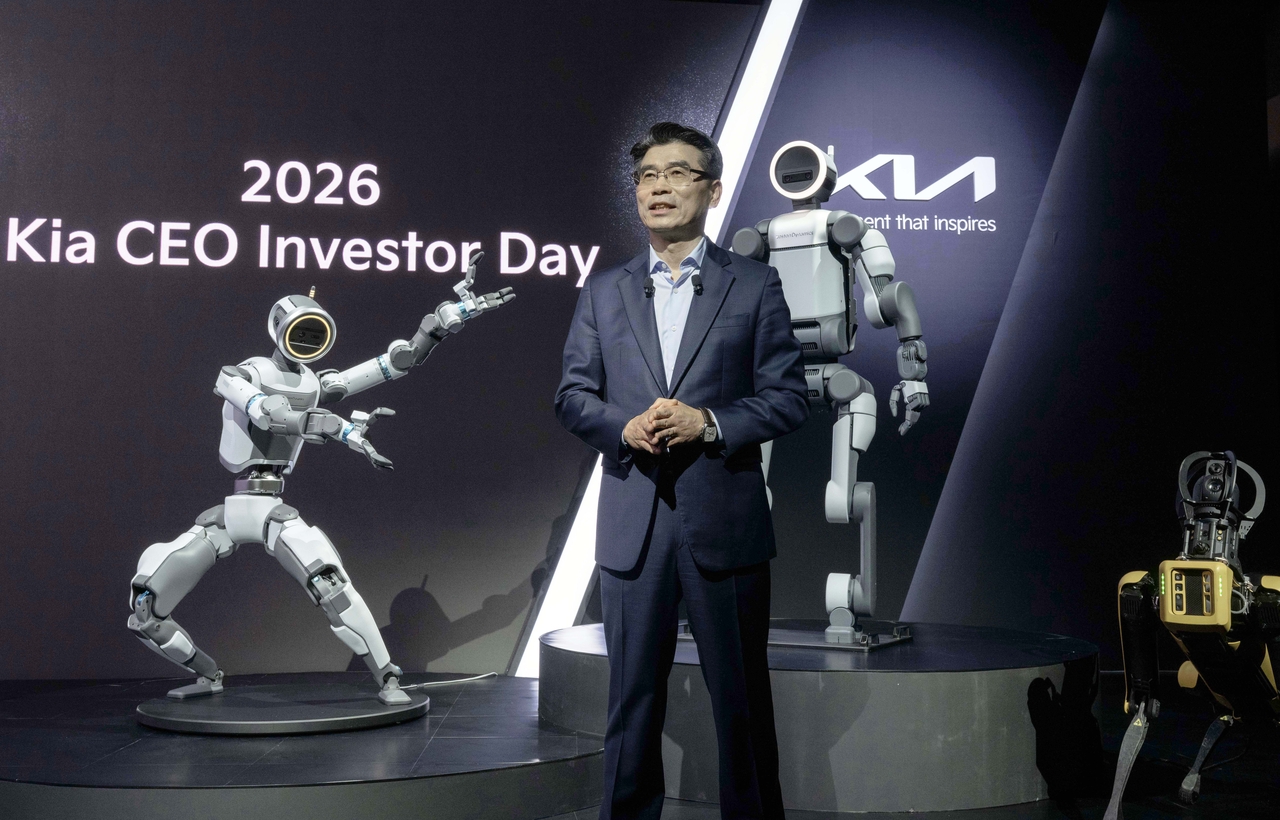
Kia CEO Song Ho-sung vowed to sell 4.13 million vehicles by 2030 to outpace a slowdown in global markets, banking on electrification and next-generation mobility, including autonomous driving and robotics.
At Kia’s 2026 CEO Investor Day in Seoul, Song outlined targets of 3.35 million units and a 3.8 percent market share by 2026 rising to 4.13 million units and 4.5 percent by 2030.
A core pillar of this “outperforming growth” is a strong eco-friendly lineup, with Kia aiming to sell 1 million electric vehicles and capture a 3.8 percent market share by 2030. Starting with compact SUVs — the EV2 and Syros EV — this year, Kia will expand its lineup from 11 to 14 models across passenger cars, SUVs and purpose-built vehicles.
The company is also advancing a next-generation EV platform that will boost battery capacity by up to 40 percent and improve motor output by 9 percent, alongside Level 2++ autonomous driving features — technology that delivers convenience and safety approaching Level 3 conditional autonomous driving, which allows for hand-off, eyes-off operation.
Korea will serve as Kia’s global EV hub, with production centered at its Gwangmyeong and Hwaseong plants in Gyeonggi Province. At the same time, the company will localize production — building models such as the EV2 and EV4 in Europe, EV6 and EV9 in the US and strategic EVs like Syros EV and Carens EV in India — to better align with local demand and regulations.
Kia plans to further expand its internal combustion engine and hybrid lineups, reflecting diverging paces of electrification across global markets. By 2030, the company will launch nine new gas-powered models and operate a total of 13 hybrid models, with sales targets of 1.98 million internal combustion engine vehicles and 1.15 million hybrids, including plug-in and extended-range models.
Key hybrid models include the Telluride and Seltos SUVs and K4 sedan, while in the pickup segment, which it entered with the Tasman in 2025, the company plans to introduce a body-on-frame extended-range electric vehicle pickup lineup for North America by 2030.
To achieve its 2030 global sales target, Kia outlined a profit-driven approach for the strategically important US market. It will focus on expanding its hybrid lineup, strengthening SUV offerings and entering the pickup segment, targeting 1.02 million sales and a 6.2 percent market share.
In Europe, Kia aims to solidify EV leadership, targeting 746,000 sales and a 4.8 percent market share, with battery-powered vehicles accounting for 66 percent of total sales. In emerging markets, the company plans to reach 1.48 million sales by expanding its lineup, boosting eco-friendly models and strengthening local production, particularly in India and other high-growth regions.
For its autonomous driving business, Kia is pursuing a dual-track strategy — accelerating market entry through global partnerships, including with Nvidia, while advancing its in-house end-to-end self-driving capabilities using extensive automotive data.
The company aims to complete its first software-defined vehicles by 2027 with Level 2+ highway autonomy, followed by Level 2++ capabilities for both highway and urban driving by 2029, supported by Hyundai Motor Group’s newly developed SDV architecture, next-generation infotainment platform and AI systems.
Hyundai Motor and Kia’s commitment to gaining a technological edge goes beyond vehicles to the rapidly emerging robotics sector.
Aiming to commercialize general-purpose humanoid robots developed by Hyundai Motor Group’s US subsidiary Boston Dynamics within the next decade, the group is pursuing three key strategies: leveraging its manufacturing network for data collection, advancing AI partnerships with Google DeepMind and Nvidia and accelerating supply chain integration with its auto parts unit Hyundai Mobis.
In manufacturing, humanoid robot Atlas is set to be deployed at the Hyundai Motor Group Metaplant America in Georgia in 2028, followed by Kia’s Georgia plant in 2029, with gradual expansion across global facilities. The rollout will focus on 16 key automotive production processes to enhance safety, productivity and quality.
Tapping into the $288 billion last-mile delivery market, the group also intends to develop a full-stack solution that integrates Kia’s PBVs with Stretch and Spot robots.
Song said the company is poised for “accelerated growth, driven by EVs, hybrids, autonomous driving and robotics, building on five years of innovation across its brand, EV, PBV and ESG (environmental, social and governance) initiatives.” He added that Kia will proactively respond to market shifts with differentiated strategies despite rising uncertainties.
hyejin2@heraldcorp.com

![[Graphic News] S. Korea ranks 9th in noodle consumption](https://wimg.heraldcorp.com/news/cms/2026/09/29/news-p.v1.20260929.e3945338add94d57ab3f00f8e6781416_T1.gif?type=h&h=800)