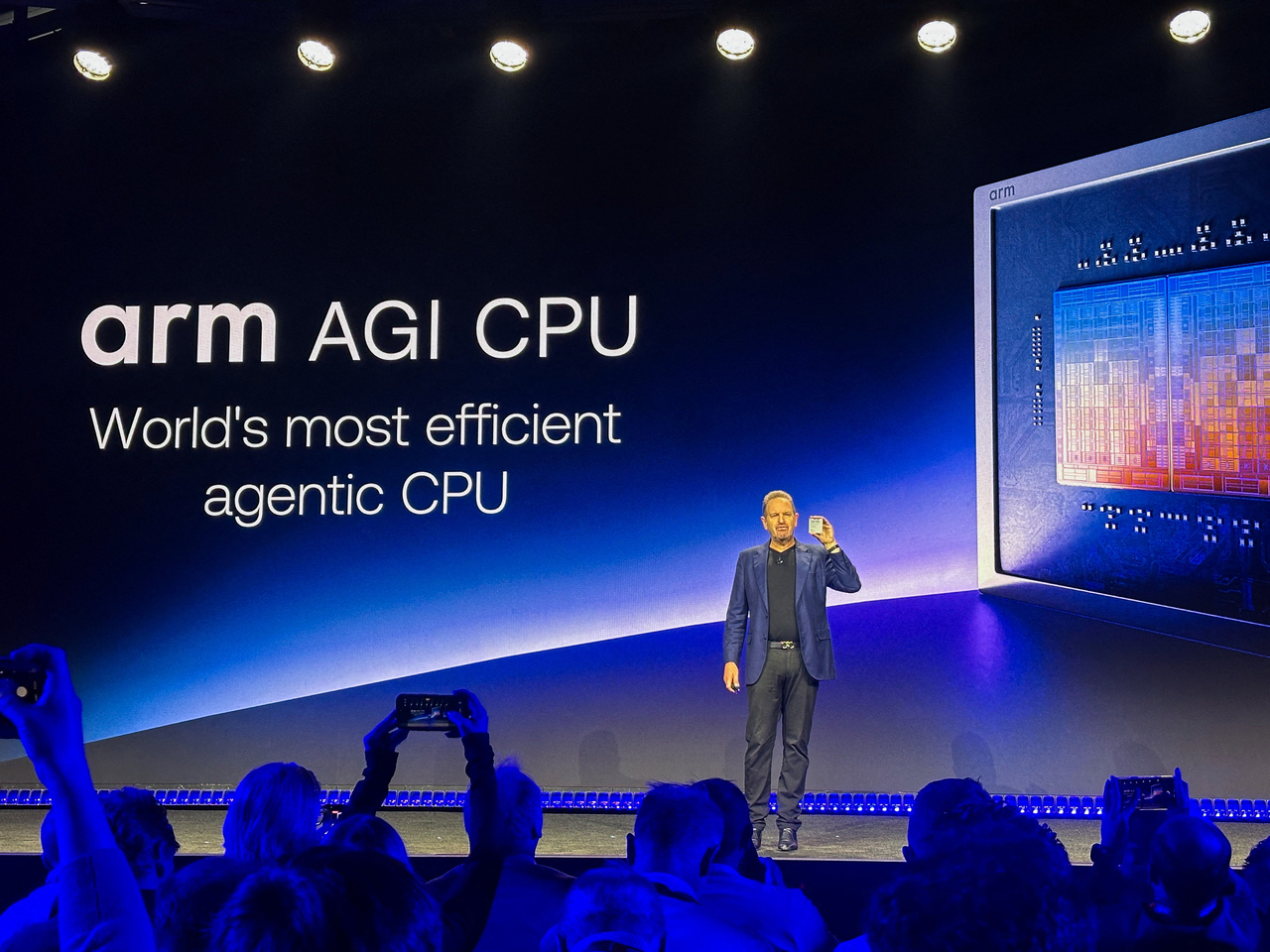
Arm Holdings, which made its name licensing technology to semiconductor makers, will begin selling its own chips for the first time, adding a business that it expects to generate about $15 billion annually within five years.
Meta Platforms will be the first major customer for the company’s chip, called an AGI CPU, Arm said Tuesday at an event in San Francisco. The product will have as many as 136 cores — a measure of processing power — and draw 300 watts of electricity, Arm said. Taiwan Semiconductor Manufacturing Co. will produce the chips.
As part of the move, Arm laid out aggressive sales targets for the coming years. The UK-based company expects revenue from the new chip business to eclipse sales from its current operations, which focus on selling intellectual property.
That will help generate total sales of roughly $25 billion within five years, five times the level today, Arm said. The IP business will continue growing, hitting about $10 billion by that point, the company predicted.
Earnings will reach $9 a share in that time frame. Analysts have estimated that earnings will be $1.75 a share in the current fiscal year, excluding some items.
Under Chief Executive Officer Rene Haas, Arm has shifted from its roots as a provider of smartphone technology and taken a greater role in the data center market. The change is meant to help the business get more of the money generated by what is often complex and expensive work.
The shift also helps Arm benefit from bigger-ticket purchases. Even the most expensive smartphone chips cost tens of dollars. The highest-end data center semiconductors can run in the tens of thousands.
The new sales outlook sent Arm shares up as much as 7.8 percent in late trading. They had climbed 23 percent this year through the close.
Chief Financial Officer Jason Child said that while Arm’s current offerings — semiconductor designs and technology licenses — are more profitable in terms of margins, selling actual chips will bring in far more profit dollars.
On a theoretical $1,000 chip, Arm gets about 5 percent in licensing revenue when customers use its instruction set — the basic code a chip uses to communicate with software. That’s pure profit. But if the client uses Arm’s designs, the profit payoff is about $100. And if Arm makes the chip itself, it gets about $500 in gross profit dollars, he said.
Arm decided to make the new chip because customers asked for it, Haas said. The product — a central processing unit, often described as the brains of a computer — is designed to work alongside the accelerator chips offered by companies such as Nvidia. It helps coordinate work between computers, prepares data and runs elements that provide a response to users making AI queries, Arm said.
“The product that we’re building is not only compelling — but we actually have customers who are lined up to buy it,” Haas said in an interview.
The company said its product offers greater power efficiency compared with traditional CPU designs from Intel and Advanced Micro Devices Inc. That means that data center owners will be able to wring more computing power from the same footprint and electricity budget, Haas said.
Arm’s increasing reach is a direct threat to the "x86 data center products" made by Intel and AMD, Haas said. Taking share from those traditional stalwarts in a rapidly expanding market will allow both his company and its customers to grow, he argues.
“The market is plenty big enough for multiple players,” Haas said.
Arm faces plenty of competition in data center processors. A number of startups and established companies have sought to challenge Nvidia’s dominance in the field with a variety of approaches. And Nvidia itself just introduced a new CPU lineup, targeting the category that Arm is now entering. Haas said his chip is aimed at a different part of the market than Nvidia’s latest addition.
Arm’s chip move also threatens to complicate its relationship with customers. Most of the biggest buyers of data center silicon, including Meta, have their own in-house chip programs. And almost all of them license technology and designs from Arm.
Data center operators buy chips from a range of suppliers. That includes Meta, which recently signed long-term deals with Nvidia, AMD and startup Cerebras Systems. The social networking company plans to use the AGI CPUs with its other chips.
“We worked alongside Arm to develop the Arm AGI CPU to deploy an efficient compute platform that significantly improves our data center performance density,” Santosh Janardhan, head of infrastructure at Meta, said in a statement.
Other companies — including OpenAI, Cerebras and SK Telecom — also plan to deploy the AGI CPU in their infrastructure, Arm said. Off-the-shelf systems using the chip are out now from sellers such as Quanta Computer and Super Micro Computer. They should be available in greater volumes in the second half of this year, Arm said. (Bloomberg)