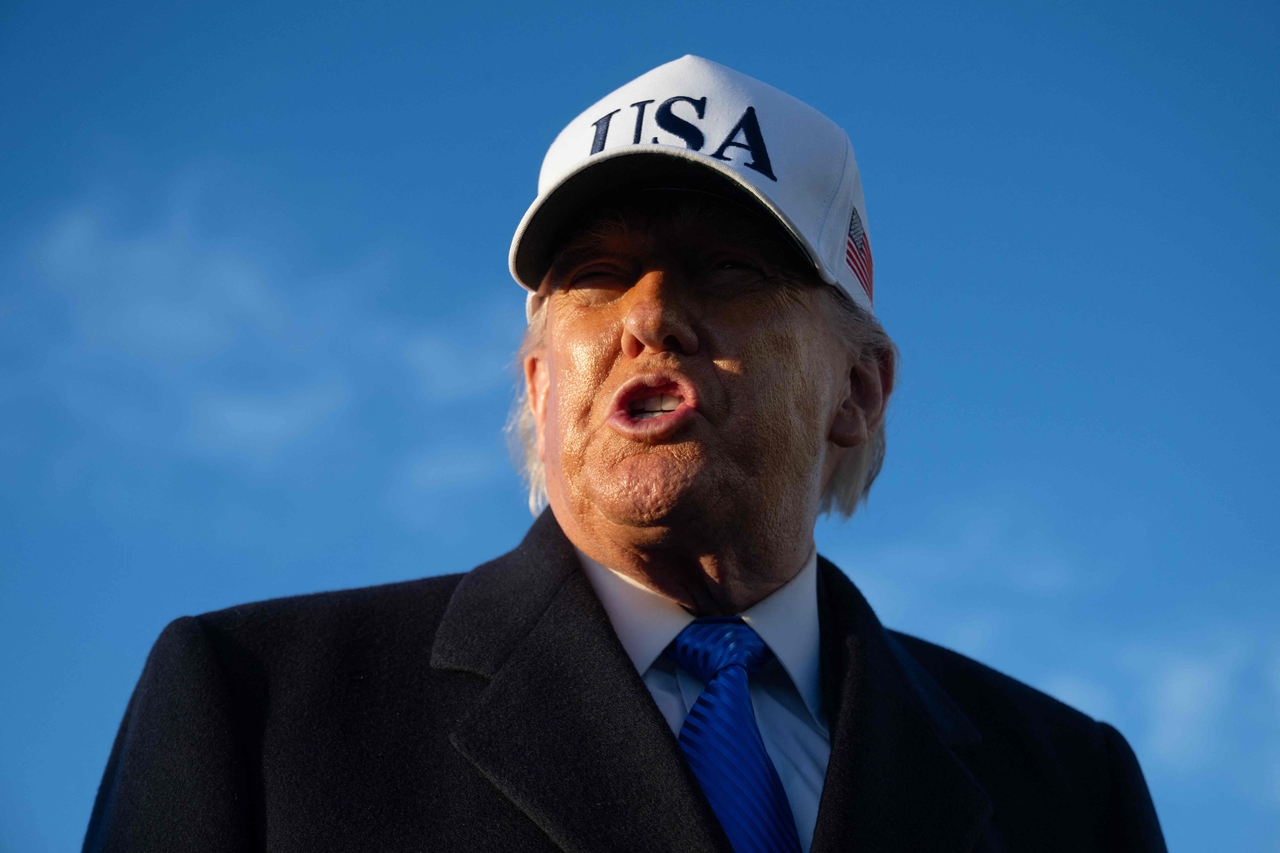
Civic groups in South Korea urged the government Sunday to reject any US request to send warships to the Strait of Hormuz, warning that involvement in rising tensions with Iran could expose the country to security risks and legal challenges.
The criticism, led largely by progressive and liberal organizations, came after US President Donald Trump called on countries including South Korea to deploy naval forces to the strategic waterway, where Iran has mounted a blockade and attacked several civilian vessels.
Seoul has said no formal request has been received, but officials are reviewing possible responses following Trump’s remarks on social media.
The groups warned that Korean involvement could run counter to domestic and international law while also weakening the country’s security posture by diverting military resources away from the Korean Peninsula.
On Sunday, People’s Solidarity for Participatory Democracy issued a statement calling on the government to firmly reject any request to dispatch South Korean troops to the area.
“Sending a naval vessel there would likely be interpreted as joining US-led military activity and could make South Korea a target of Iran,” the statement said, referring to recent Iranian attacks on US military bases and embassies in the Middle East.
“It would neglect the government’s duty to protect the safety of Korean nationals and companies overseas and risk unnecessarily making the country a target.”
The group also warned that dispatching forces to the Middle East could weaken South Korea’s defense readiness in Northeast Asia, where security tensions remain high amid stalled inter-Korean dialogue.
“South Korea’s military capabilities should primarily be focused on safeguarding the Korean Peninsula, not on military operations in a Middle Eastern conflict zone,” the statement added.
Other progressive groups, including the Korean Confederation of Trade Unions, also voiced opposition to potential involvement. The union urged the US to halt military pressure on Iran and called on the Korean government to clearly reject any request for troop deployment.
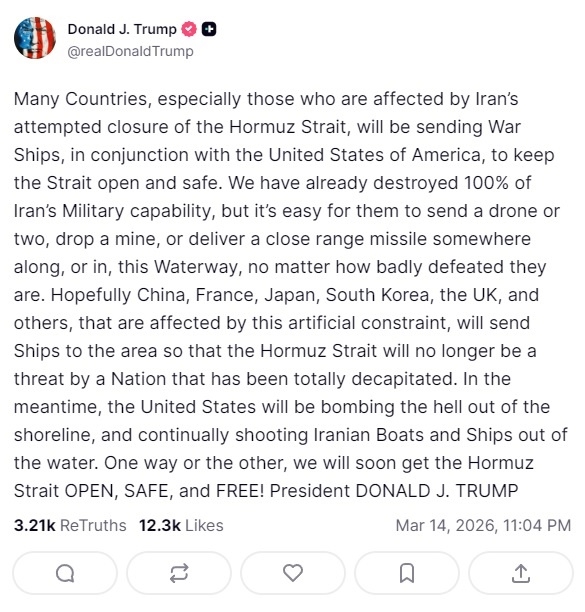
The criticism followed a post by Trump on his social media platform Truth Social on Saturday, in which he called on countries affected by Iran’s blockade of the Strait of Hormuz to contribute naval forces to "keep the Strait open and safe." He named China, France, Japan, the United Kingdom and South Korea.
Meanwhile, energy concerns have grown in South Korea after seven crude oil carriers were reportedly delayed while returning to the country. The government has also temporarily capped fuel prices at gas stations starting Friday, the first such measure in about 30 years.
South Korea maintains strategic petroleum reserves equivalent to more than 68 days of supply. However, roughly 70 percent of its crude oil imports pass through the strategic chokepoint.
Government sources said no official request has been made, but analysts say the Cheonghae Unit, currently deployed in the Indian Ocean to protect commercial vessels from piracy, could be considered if a multinational mission is formed.
The unit was previously dispatched to the Strait of Hormuz in 2020 to safeguard Korean commercial ships. However, the analysis notes that a new deployment could face greater legal hurdles, including the need for approval from the National Assembly.
“The dispatch of forces to the Strait of Hormuz would fall outside the mission scope approved by the National Assembly for the Cheonghae Unit,” the Korea Civil Peace Forum said in a statement Sunday. “The government should not accept any request to send the unit or any other military force against Iran.”
forestjs@heraldcorp.com