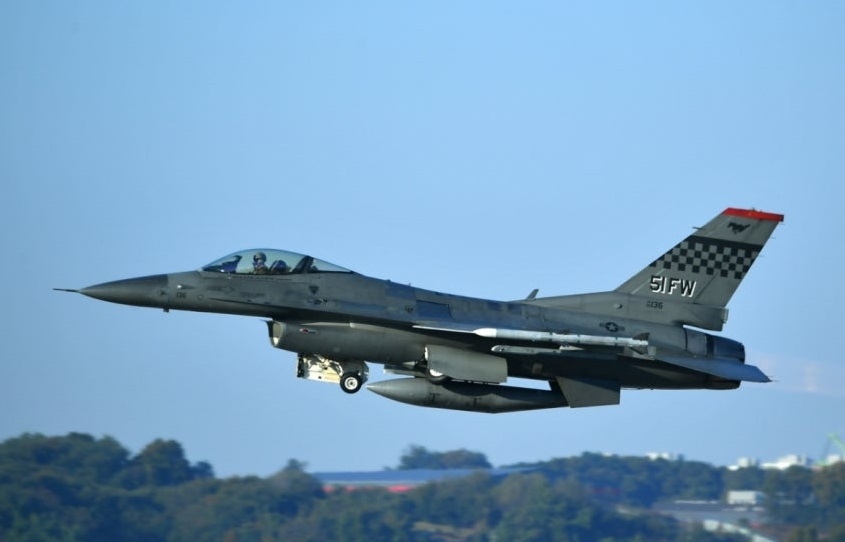
US Forces Korea and Chinese fighter aircraft engaged in a brief aerial face-off over the Yellow Sea earlier this week after a rare US Air Force exercise prompted Beijing to deploy its own jets, military sources said Friday.
According to multiple sources, 10 USFK F-16 fighter jets took off from Osan Air Base in Pyeongtaek late Wednesday and flew over international waters in the Yellow Sea, maneuvering toward airspace between South Korea’s and China’s air defense identification zones. The aircraft reportedly operated in areas between the Korea Air Defense Identification Zone and China’s Air Defense Identification Zone, in the airspace where the two zones do not overlap.
As the US aircraft approached, China scrambled fighter jets to the area, resulting in a brief standoff. However, neither side is believed to have violated the other’s ADIZ, and the situation did not escalate.
USFK had informed the South Korean military in advance that the exercise would take place but did not provide detailed information, including its operational plan or purpose. In cases of unilateral USFK drills that do not involve the South Korean Air Force, it is not uncommon for full details of the plan or objectives to be withheld.
South Korean military authorities conveyed concerns to the US side after becoming aware of the exercise.
Neither Seoul’s Defense Ministry nor USFK offered additional details about the incident. A defense ministry official said that, together with USFK, South Korea maintains a robust combined defense posture. The official, speaking to reporters on condition of anonymity, declined to provide details when asked what discussions had taken place with the US side and whether the drills were conducted in a routine training area, saying, “We cannot confirm.” USFK also declined to comment.
The deployment of a significant number of USFK Air Force assets near the Chinese ADIZ is considered unusual, prompting interpretations that the exercise may have been aimed at signaling deterrence toward China.
The drills come amid growing speculation that Washington may seek to adjust USFK’s role as it shifts focus toward countering China and encourages allies to assume greater responsibility for regional security.
The US National Defense Strategy released last month suggested a potential evolution in force posture, stating that South Korea is capable of taking the lead in deterring North Korea with “critical, but more limited” US backing — a change framed as part of broader efforts to update US' military presence on the peninsula.
USFK Commander Gen. Xavier Brunson has likewise emphasized the need for greater operational flexibility. In November last year, he said, “Forces already positioned on the Korean Peninsula are revealed not as distant assets requiring reinforcement, but as troops already positioned inside the bubble perimeter that the US would need to penetrate in the event of crisis or contingency,” underscoring the US position that USFK could play a broader role in deterring regional threats.
An ADIZ is a self-declared zone established to enable early identification and communication with foreign aircraft before they enter sovereign airspace; it is distinct from territorial airspace. While an ADIZ does not confer sovereignty, it is customary for foreign aircraft entering such zones to provide prior notification to the relevant country.
The Korean ADIZ was established by the United States in March 1951, while China declared its East China Sea ADIZ in November 2013. On Dec. 9 last year, Chinese and Russian military aircraft entered the Korean ADIZ over the East Sea and South Sea, prompting South Korea’s Defense Ministry to lodge a strong protest.
mkjung@heraldcorp.com



![[Graphic News] Average parental age of S. Koreans rises](https://wimg.heraldcorp.com/news/cms/2026/09/27/news-p.v1.20260927.0bcbf944ca9043c4a6ad4401fcfae25c_T1.gif?type=h&h=800)