US remains largest holder, Ireland leads net purchases
Foreign ownership of Korean equities nearly doubled in 2025 as the Kospi’s world-beating rally drove a surge in market value, with the figure continuing to snowball as the index shows no signs of cooling.
Overseas investors held 1,326.8 trillion won ($918.9 billion) worth of shares listed on Seoul markets at the end of December, according to Financial Supervisory Service data released Wednesday, up 97 percent from 673.7 trillion won a year earlier.
The increase came even as foreigners posted net sales of 11.8 trillion won during the year. A roughly 76 percent surge in the Kospi — the strongest among major global markets — more than offset the outflows and boosted the value of retained holdings.
Foreign ownership as a share of total market capitalization rose to 30.8 percent from 27 percent a year earlier, the data showed.
By registered country, US investors saw their holdings nearly double from 272 trillion won at the end of 2024 to 546 trillion won a year later. Their share of total foreign ownership also edged up to 41.2 percent from 40.4 percent, extending their lead.
UK-based investors ranked second with 144 trillion won in holdings, followed by Singapore at 88 trillion won, Luxembourg at 70 trillion won and Ireland at 58 trillion won.
By net flows, Ireland was the largest buyer with net purchases of 7 trillion won, followed by the US with 5.8 trillion won. The UK was the largest seller, with net sales of 11.1 trillion won.
In trading activity, UK investors were the most active, recording total transactions of 1,031 trillion won, comprising 519 trillion won in sales and 511 trillion won in purchases. They accounted for 46 percent of total foreign trading volume in Korean equities last year.
The momentum carried into 2026. Foreign holdings rose to 1,701 trillion won at the end of January, up 28 percent from a month earlier, despite net foreign selling of 98 billion won.
During the month, foreigners posted net purchases of 361 billion won on the Kospi and net sales of 459 billion won on the Kosdaq. Ireland led purchases with 233.2 billion won, followed by the UK with 175.8 billion won; US investors offloaded a net 779.5 billion won, extending their net selling streak to a fourth consecutive month.
Foreign ownership as a share of market capitalization climbed 1.2 percentage points to 32 percent.
The Kospi surged 24 percent in January, breaching 5,000 for the first time on Jan. 22 and adding roughly 500 points over the next two weeks. The Kosdaq also rose 24 percent, building on a 37 percent rally in 2025.
The surge lifted valuations across the board. Forty-two stocks crossed the 1 trillion won market capitalization threshold in January, bringing the total to 365, up 13 percent from a month earlier. The number of stocks valued above 10 trillion won in market capitalization rose by 12 to 74, including 10 from the Kospi and two from the Kosdaq.
Notably, Samsung Electronics surpassed 1,000 trillion won in market value in January, becoming the first Korean company to reach the milestone.
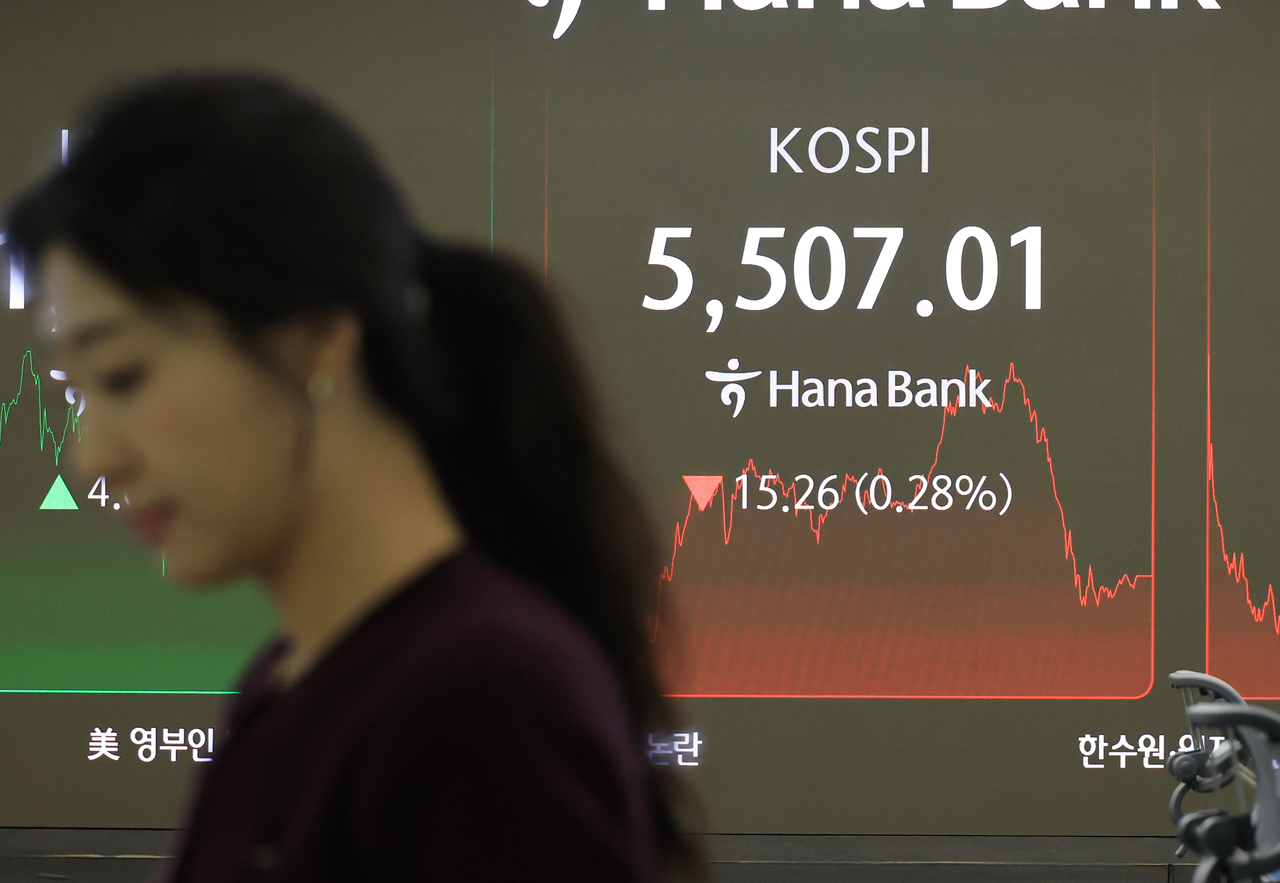
On Friday, the benchmark hit an all-time intraday high of 5,583.74 before closing almost flat at 5,507.01.
As of Friday’s close, the Kospi and Kosdaq had gained 30.7 percent and 19.5 percent, respectively, since the end of 2025, ranking as the strongest and third-strongest performers among major global markets so far this year. Turkey followed with a 26 percent advance, while Brazil and Taiwan posted gains of more than 16 percent.
While foreign demand softened late in 2025 — snapping a six-month streak of net buying on the Kospi and leaving overseas investors as net sellers for the year — many analysts expect foreign inflows to strengthen through the year.
JPMorgan, which recently raised its 2026 Kospi target to 6,000 in its base case and 7,500 in its bull case, said foreign positioning remains “lukewarm,” suggesting ample room for renewed inflows.
Kim Yong-gu of Yuanta Securities also cited stronger foreign participation as a key driver, saying “Korea’s differentiated overweight status within global and emerging markets should attract additional inflows,” and raised his Kospi target range to 5,000 to 6,300.
jwc@heraldcorp.com
![[Graphic News] Korea’s marine waste up 20% in 4 years](https://wimg.heraldcorp.com/news/cms/2026/10/27/news-p.v1.20261027.091c35e4ae1a4bb2a598a9138e673a7b_T1.gif?type=h&h=800)