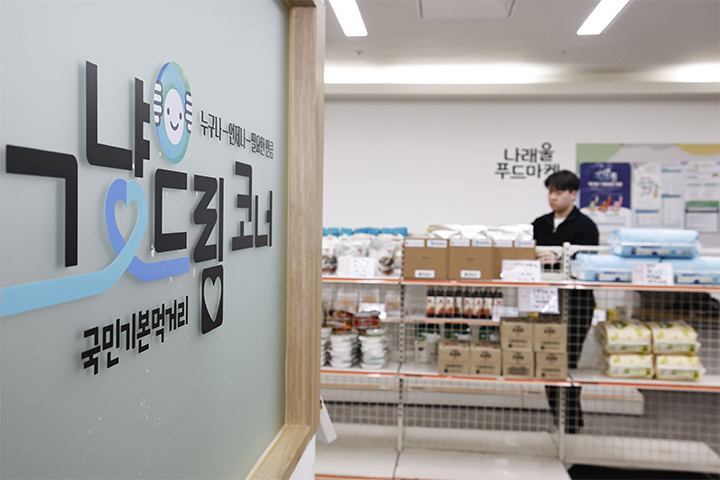
South Korea’s new food bank-style welfare program is drawing questions over access, feasibility and uneven local participation, even as the government plans a rapid nationwide expansion.
The Ministry of Health and Welfare said Thursday that the “Just Give Center,” currently operating at 107 sites in 67 cities and counties, will grow to about 300 locations by the end of 2026.
The program launched in December provides up to 20,000 won ($13.70) worth of ready-made meals and daily necessities without requiring recipients to prove income or asset levels. It is supported by a 12.9 billion won budget.
During the two-month pilot period, the government said the centers assisted people without resident registration and foreign nationals and served as entry points for connecting visitors with local welfare officials, particularly those who lack information or the ability to navigate existing benefits.
From the second visit onward, the centers conduct consultations with visitors. About one in six users received counseling, with 2,200 undergoing in-depth sessions and roughly 200 being connected to other welfare programs, according to the ministry.
The initiative builds on a policy promoted by President Lee Jae Myung when he served as governor of Gyeonggi Province and is positioned as a key measure to reduce welfare blind spots.
"There were concerns that reduced verification would lead to abuse, such as people driving a Mercedes-Benz to collect benefits, but we found hardly any such cases during the pilot,” Lee said at a cabinet meeting Tuesday.
"Before full-scale implementation in May, we must correct shortcomings and actively consider expanding locations."
To prevent duplicate benefits, existing local food bank recipients are excluded from the program, and transactions are recorded on a shared nationwide system.
However, the program’s minimal screening requirements have raised concerns about whether limited resources are reaching those most in need.
Local officials say shortages of supplies and staff could limit access for residents in severe hardship. Yeo Jae-man, a member of the Incheon Gyeyang-gu Council, said people in crisis are often unable to travel early or wait in line.
"A first-come, first-served system disadvantages them,” he said. "Distributing scarce goods based on arrival speed does not align with the purpose of welfare."
Funding has also emerged as a hurdle, as the program relies on a one-to-one cost-sharing arrangement between central and local governments.
In South Gyeongsang Province, Gimhae is the only city operating a center, with 17 other municipalities citing budget constraints and overlapping welfare programs.
“We are consulting with the Interior Ministry and the Finance Ministry to ease the burden on local governments and are exploring ways to lower operating costs and adjust distribution volumes,” a Welfare Ministry official told The Korea Herald.
The ministry said it is reviewing successful pilot cases, such as emergency assistance provided to foreign workers who lost housing to fires, to refine and expand the model.
“We aim to strengthen (the program's) role as a safety net for groups still outside the welfare system, including foreign nationals and homeless people without resident registration,” the official added.
forestjs@heraldcorp.com