Top court overturns record W1.38tr divorce payout for SK chief
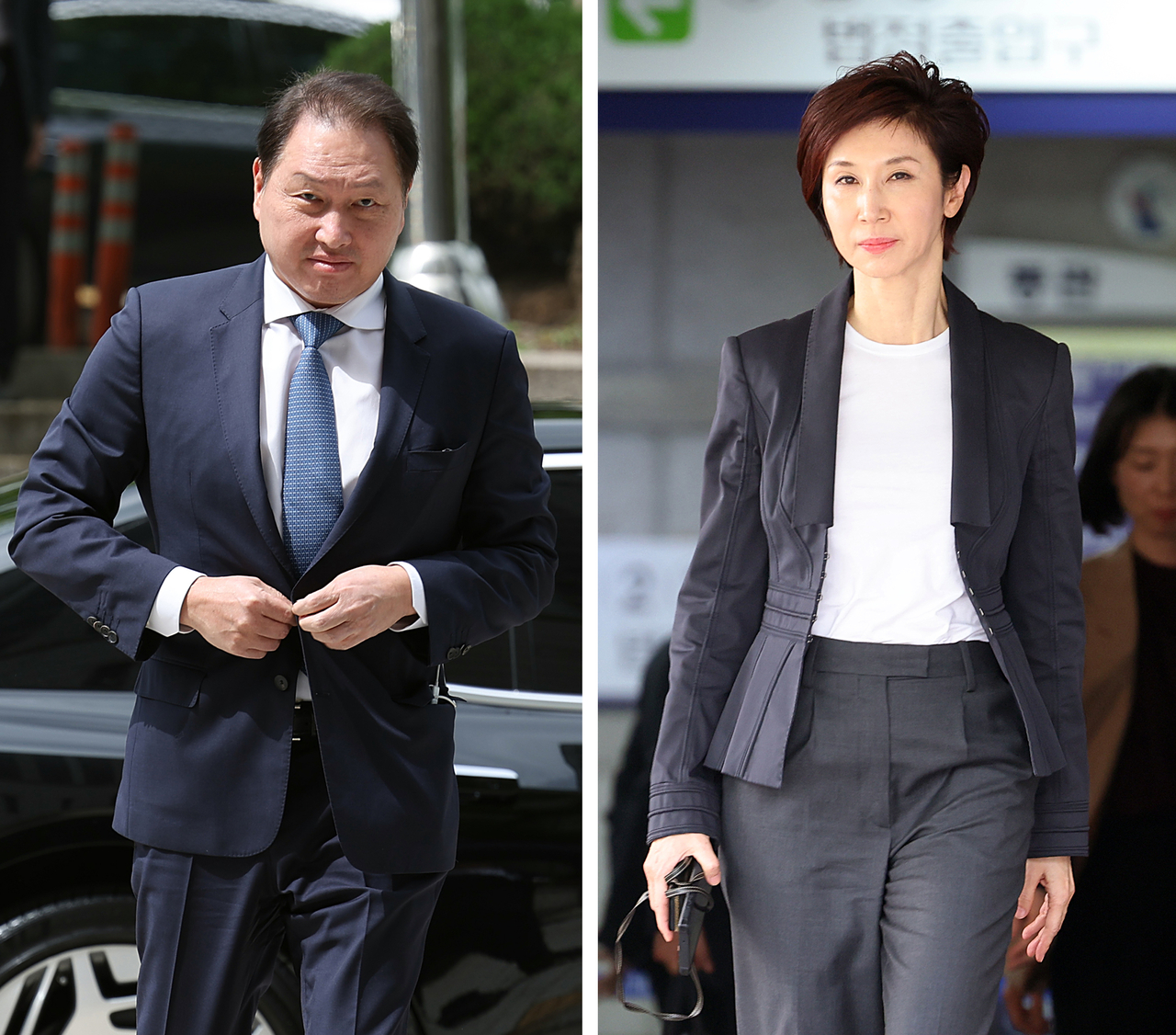
The Supreme Court on Thursday overturned a lower court ruling that ordered SK Group Chair Chey Tae-won to pay 1.38 trillion won ($973 million) to his estranged wife, Roh Soh-yeong, in their high-profile divorce lawsuit. The case has been remanded back to the appellate court for reconsideration, citing flaws in the property division.
Thursday’s ruling lifts, at least temporarily, the immediate financial burden on Chey, who might have had to liquidate part of his shares controlling SK Group to cover the colossal payout if the court had upheld the verdict of the country’s largest ever divorce settlement. It also calmed investor jitters over a potential shake-up in the ownership structure of SK Group, the nation’s second-largest conglomerate, spanning industries from semiconductors to energy and telecommunications.
In July last year, Chey appealed the Seoul High Court's May ruling that ordered him to pay 1.38 trillion won in property division and 2 billion won in alimony to Roh, the daughter of former President Roh Tae-woo. He argued that a substantial portion of the group’s value was inherited and thus should be exempt from division, as inherited assets are not subject to divorce settlements under South Korean law.
The sum in the May ruling represented a substantial increase from the initial court decision of 66.5 billion won, reflecting what the appellate court viewed as the contributions made by Roh and her father in SK Group's growth and Chey’s business activity.
In its ruling, the Supreme Court said the appellate court’s ruling misapplied the law by including a 30 billion won fund in the couple’s marital assets calculation. The fund was allegedly provided by Roh Tae-woo and given to Chey’s father, the late SK Group founder Chey Jong-hyon.
According to the court, even if Roh Tae-woo provided the 30 billion won to Chey Jong-hyon, “the source of the money appears to be a bribe” received during Roh’s presidential term. The court added that the slush fund was illegal and so not protected or to be counted toward the younger Roh’s contributions to the couple’s divisible property.
“Roh Tae-woo’s act of providing a large sum of money to his in-laws or his children and spouses as part of a bribe, and keeping it silent, making it impossible for the state to trace and collect the funds, is against good customs and social order, and is clearly antisocial, unethical and immoral, and falls outside the scope of legal protection," the court said in its ruling.
However, the Supreme Court upheld the 2 billion won one-off alimony payment granted to Roh, dismissing Chey’s appeal on that portion.
“We are relieved that the Supreme Court’s ruling has rectified several misinterpretations of law and factual errors made in the appellate court’s decision,” Chey’s legal representative, lawyer Lee Jae-keun, told reporters after the ruling. “In particular, the Supreme Court’s declaration that SK Group’s growth cannot be attributed to the Roh administration’s illegal funds, and therefore cannot be recognized as a contribution to marital property, is especially meaningful.”
The case will return to the high court for fresh proceedings, prolonging an eight-year legal battle that started when Chey filed for divorce in 2017, two years after he publicly admitted to an extramarital relationship and fathering a child outside the marriage in 2015.
Chey and Roh married in 1988 and have three children together.
While Thursday's decision averted temporary financial pressure for Chey, he still cannot rest easy. The eventual outcome of the property division in the retrial could again affect his grip on the conglomerate and ownership structure.
Chey effectively controls SK Group through holding a 17.9 percent stake in SK Inc., the group’s holding company. Even partial sales of his stakes, valued at around 2.81 trillion won as of Thursday, could jeopardize his control of the conglomerate or expose it to potential hostile takeovers.
Observers say the amount of the property division is expected to be significantly reduced in the retrial, which would lessen the need for Chey to sell stakes in SK Inc. to raise cash for the payment. Instead, he may cover the payment by offloading part of his 29.4 percent stake in SK Siltron, a key nonlisted semiconductor materials unit.
Still, the divorce dispute is far from over. The remanded proceeding will likely extend a legal battle that has already lasted eight years.
Shares of SK Inc. fell 5.62 percent to 218,500 won on Thursday.
sahn@heraldcorp.com