Korean tech rivals look to chip away at Apple’s AirPods dominance with cheaper, feature-rich alternatives
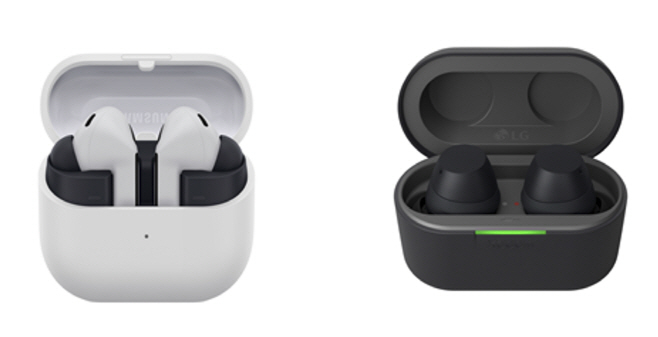
As global consumers increasingly prioritize affordability in personal tech, South Korean electronics giants Samsung Electronics and LG Electronics are stepping up their game in the wireless earbuds market, aiming to undercut Apple’s longstanding dominance with value-driven alternatives.
Wireless earbuds priced below 200,000 won ($142) are typically categorized as mid- to low-end offerings. While Apple’s AirPods continue to symbolize the high-end segment, competitors such as Xiaomi, Samsung and now LG are gaining momentum by offering competitively priced models equipped with user-friendly features.
A recent report by market research firm Canalys showed that Apple led the global wireless earbud market in the first quarter with a 23.3 percent market share. Xiaomi followed with 11.5 percent, while Samsung and Huawei trailed at 7.1 percent and 6 percent, respectively. Notably, Xiaomi recorded a significant 7.8 percentage point on-year increase, whereas Apple’s share dipped by 1 percentage point during the same period.
In a strategic move to capture the budget-conscious segment, LG recently launched the Xboom Buds Plus and Xboom Buds Lite, priced at 199,000 won and 99,000 won, respectively. These follow the January release of its mid-tier Xboom Buds, which debuted at 149,000 won.
Samsung, meanwhile, unveiled its Galaxy Buds3 FE at IFA 2025 in Berlin earlier this month. The model, positioned as a more accessible version of the Galaxy Buds3 released last year, officially launched in Korea on Sept. 19 for 159,000 won.
Apple, undeterred by rising competition, recently introduced its next-generation AirPods Pro 3. The premium earbuds boast enhanced audio fidelity, improved active noise cancellation and new features such as heart rate monitoring for fitness tracking. Retailing at 369,000 won, the model costs two to three times more than the latest budget offerings from rivals.
According to data from Counterpoint Research, earbuds priced under $50 accounted for 49 percent of global shipments last year, the largest share among all price tiers. On the contrary, high-end models priced above $150 saw their market share decline from 27 percent in 2023 to 22 percent in 2024. Meanwhile, mid-range products in the $101–149 range showed growth, increasing from 8 percent in 2023 to 15 percent last year.
“Unlike smartphones or tablets, where pricing trends are increasingly polarized, the wireless earbuds market is tilting toward value-driven consumption,” said an industry source who requested anonymity.
“Consumers today are not only looking for cost-effective options but also demand personalized experiences and enhanced usability.”
The source added that as Samsung and LG broaden their product portfolios in response to these evolving preferences, competition in the budget segment is expected to heat up. “This shift could gradually narrow the market share gap between Apple and its competitors,” he said.
yeeun@heraldcorp.com