KIPO chief outlines plan to turn strong, high-value patents into engines of growth amid global uncertainty
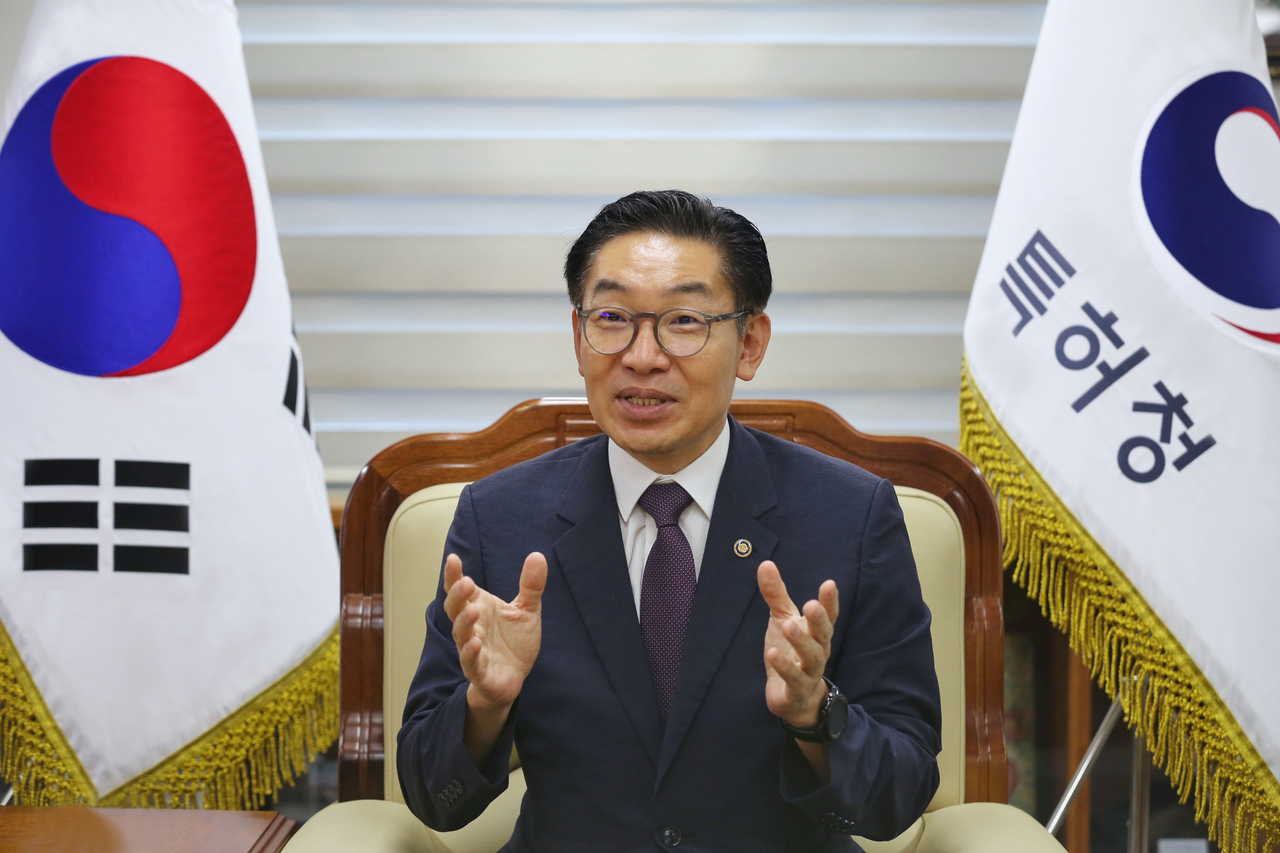
The Korean Intellectual Property Office is steering a shift toward what it calls “luxury patents” — high-quality, business-driving intellectual property that the agency sees as a key part of Korea’s next economic leap.
KIPO Commissioner Kim Wan-ki, in an interview with The Korea Herald, described luxury patents as “strong, money-making patents” that secure broad exclusive rights, are clear and enforceable against third parties, and carry significant economic value.
“South Korea already ranks fourth in global patent filings and international applications, and third in standard-essential patents,” Kim said. “But our IP trade balance has remained in deficit: $24.6 billion in 2022, $16.6 billion in 2023 and $18.4 billion so far this year. This shows that while we are strong in quantity, we must improve in quality. Luxury patents will provide the real growth engine.”
To achieve this, KIPO is restructuring its policies around four pillars: securing high-value patents in advanced industries through research and development analysis, facilitating commercialization and exports of these patents to generate tangible profits, establishing a fair market order that fully recognizes the value of IP, and innovating examination procedures to ensure broad and stable rights.
“This is about building an ecosystem where Korea can restore growth potential and economic vitality, and ultimately position itself as a future-leading industrial powerhouse,” Kim said.
IP as safeguard in uncertain times
Kim highlighted that IP plays a central role in overcoming today’s global volatility. Vaccines, artificial intelligence, autonomous driving technologies, semiconductors and secondary batteries all illustrate how innovation translates into economic value when underpinned by strong IP systems.
He noted that in Korea, gross domestic product and patent filings show a clear positive correlation, underscoring IP’s contribution to economic growth. Despite global headwinds, innovation remains resilient, according to World Intellectual Property Organization statistics.
Advanced economies are also seeing explosive growth in next-generation fields: Global AI patent applications rose from 875 in 2015 to 13,402 in 2022; quantum technology filings from 424 to 2,533; and advanced biotech filings from 14,799 to 26,892 in the same period.
“At this year’s WIPO General Assembly in July, I stressed that strengthening the global IP ecosystem is the key to overcoming economic uncertainty,” Kim said.
Closing global IP divide
One of the biggest challenges, Kim said, is the widening “IP divide” between developed and developing nations, a gap deepened by the rapid rise of AI and digitalization.
“Advanced countries have infrastructure but face shortages of young researchers due to aging populations. Developing nations, meanwhile, have talent and dynamism but lack the IP systems to support it,” he explained.
Korea, once one of the world's poorest countries in the 1950s, has built a world-class IP framework at record speed. Through the Korea Funds-in-Trust at WIPO, it has run numerous capacity-building programs, including current efforts to help East Timor establish its first national IP office. In June, KIPO hosted a training program in Korea on establishing and managing such an office for East Timor officials.
“We hope our experience can help developing countries strengthen their IP infrastructure, close the divide and stimulate global innovation,” Kim said.
AI’s disruptive impact
Kim also addressed the profound changes brought by artificial intelligence. Beyond generative AI and large language models, new forms such as manufacturing AI, which optimizes production through data analysis, and physical AI, which combines robotics with AI, are expected to transform manufacturing industries.
According to WIPO, global filings for generative AI patents have grown by an average of 39 percent annually over the past decade, while more than 80 percent of all manufacturing AI patent applications were filed in the last five years.
“These trends require systematic examination standards and the establishment of new international norms,” Kim said. “KIPO is co-leading with the European Patent Office the ‘New Technology/AI Roadmap’ under the IP5, which was adopted in 2021, and research is ongoing in law, digitalization, classification and statistics.”
Korea has also used its WIPO trust fund to host AI training workshops across Southeast Asia. In 2024, programs were held in Indonesia, the Philippines, Thailand and Vietnam to help developing countries prepare for the AI era.
Fast-tracking high-tech patents
Domestically, KIPO is advancing sector-specific “patent examination package” support systems in high-tech fields. In 2023, semiconductors were prioritized; in 2024, secondary batteries; and in 2025, biotechnology, AI and advanced robotics.
The packages involve increasing examiner headcount, creating dedicated divisions and granting priority reviews. Over the past three years, KIPO has hired 165 private-sector experts as patent examiners: 67 in semiconductors, 38 in batteries, 35 in biotech, nine in AI and 16 in robotics.
This approach has been recognized with awards from the Korean Policy Studies Association in June 2023 and the Presidential Office in December 2023.
“Hiring retired industry veterans as examiners ensures speed, rigor and quality,” Kim said. “We will continue expanding capacity in line with rising filings in advanced technology sectors.”
Building closer ASEAN links
Looking outward, Kim stressed the growing importance of the Association of Southeast Asian Nations, Korea’s third-largest trading partner and the world’s fifth-largest economic bloc.
From Sept. 1-3 this year, Seoul hosted the 8th Korea-ASEAN heads of IP offices meeting, with participation from all 10 ASEAN member states as well as East Timor, which joined the discussions as a candidate country.
The agenda focused on using AI to advance IP administration systems, strengthening IP protection and enforcement, and promoting IP finance and commercialization.
The meeting produced a joint declaration and multiple memorandums of understanding, while Korea held bilateral talks with each delegation to discuss tailored cooperation.
On Sept. 2, the Korea-ASEAN IP Symposium was also held, featuring sessions on Korea’s IP finance initiatives, business support programs, and ASEAN’s filing, examination and dispute resolution systems.
“ASEAN is central to Korea’s export diversification strategy and a vital partner in building a business-friendly IP environment,” Kim said.
By Lee Kwon-hyung (kwonhl@heraldcorp.com)
hyelimchung@heraldcorp.com