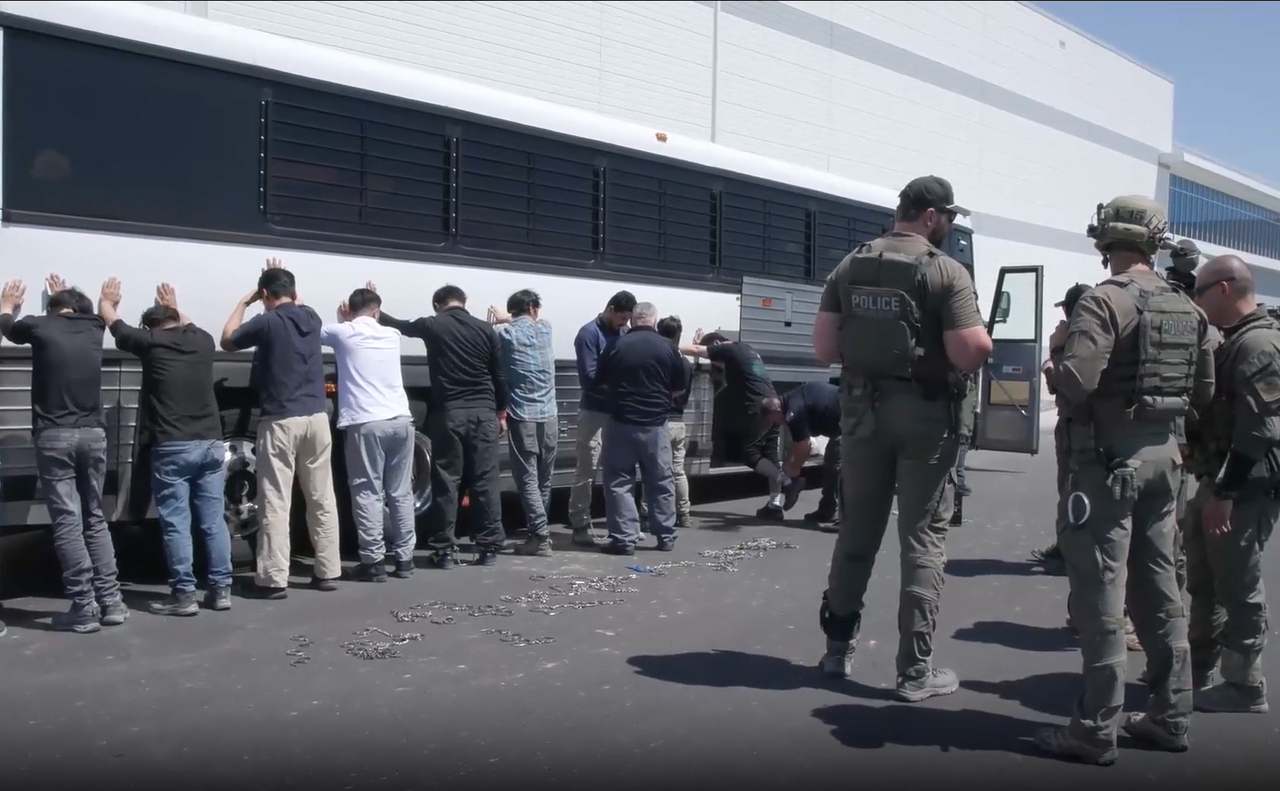
Concerns in Seoul over a massive immigration raid in Georgia that led to the detention of hundreds of Korean workers eased Sunday afternoon, after a senior presidential official announced that negotiations with Washington had concluded.
Kang Hoon-sik, chief of staff to President Lee Jae Myung, said a chartered flight was being prepared to bring the workers home upon the completion of additional administrative procedures.
Though updates on exactly when the detainees would be released had not been made available as of press time, The Korea Herald has compiled key information about the Trump administration's largest single-site immigration crackdown to date, conducted at the electric vehicle battery plant in Georgia, operated by HL-GA Battery Co., a joint venture of Hyundai Motor Co. and LG Energy Solution.
Largest single-site crackdown
Thursday’s operation was the biggest immigration raid ever carried out at a single site during the second Trump administration, which began in January.
After blocking major roads leading to the plant, some 500 investigators from different US government agencies, including the Bureau of Alcohol, Tobacco, Firearms and Explosives, Immigration and Customs Enforcement, the Federal Bureau of Investigation, the Drug Enforcement Administration and the Internal Revenue Service, reportedly raided the site, deploying helicopters and military vehicles.
The investigators detained all the construction workers at the site to verify whether they were legally residing in the United States.
After obtaining the personal information of the workers, the investigators reportedly issued temporary permits only to those whose legal status had been verified, allowing them to exit the premises, while others were transported to an immigration detention facility in Folkston, Georgia.
Arrested workers were mostly put on a bus with their hands bound by cable ties, while some had chains around both their legs and wrists.
Korean workers
According to US authorities, a total of 475 people were arrested in the operation.
LG Energy Solution confirmed Sunday that 47 of its employees — 46 Koreans and one Indonesian — were taken into custody. Almost 250 personnel working for the affiliated HL-GA Battery, mostly Koreans, were detained by US authorities.
Many of those reportedly entered the US using B1 visas — issued for business purposes, such as attending meetings or signing contracts — or through the Electronic System for Travel Authorization visa waiver program for short-term stays. US immigration officials said that was the central issue in the raid.
Foreign nationals must acquire an appropriate visa such as the H-1B, L1 or E2 to legally obtain employment at workplaces located in the US. But as those visas can take months to obtain and their numbers are capped, they are often deemed impractical for companies that need to dispatch workers frequently or on short notice. Industry officials also complain that wait times for all types of visas have lengthened since the start of the Trump administration.
According to Korean media reports, the US allocates annual H-1B visa quotas to certain countries with which it has free trade agreements, including Canada, Mexico, Singapore, Chile and Australia. Despite having a free trade agreement with the US, South Korea does not receive a quota.
In response to the concern, an official from Seoul’s Foreign Ministry, who requested anonymity, noted that H-1B visas are distributed through a lottery. The official said that the ministry has repeatedly urged the US government and Congress since 2012 to create a separate visa quota for Korean professionals, such as via the proposed Partner With Korea Act.
The most recent version of the bill, which would allow the establishment of a new E-4 visa for up to 15,000 Korean nationals per year to be employed in specialty occupations, was also initiated by Democratic Rep. Sydney Kamlager-Dove and Republican Rep. Young Kim — both of California — on July 23.
The E-4 visas would be valid for a maximum of two years and renewable indefinitely, according to the official. They are not to be linked to permanent residency eligibility.
Meanwhile, the ministry official explained that US authorities reviewed whether the activities of detained workers holding B-1 visas were consistent with the purpose of stay permitted under their visas.
The B-1 visa may be used by workers for purposes including staff training or the installation, operation or maintenance of machinery or equipment. But actual construction work is not permitted, and wages may not be paid by a US-based entity.
Detained in Georgia
The Korean workers are being held at the Folkston ICE Processing Center in southern Georgia, where immigration authorities hold foreign nationals after arrest to review their immigration status and charges against them and to determine further action, including possible deportation.
The facility had been flagged for poor conditions after an inspection was conducted by the Department of Homeland Security in 2021.
According to the DHS report, “Violation of ICE Detention Standards at Folkston ICE Processing Center and Folkston Annex,” Folkston facilities were unsanitary and dilapidated, with torn mattresses, water leaks, mold growth and water damage, rundown showers, mold and debris in the ventilation system, insect infestations, inoperable toilets, the absence of hot meals and other violations.
The inspectors added that the facility’s medical staff did not provide timely access to specialized care or adequate mental health treatment for detainees.
The Office of Inspector General reportedly determined that ICE had accepted most of its recommended improvements.
But human rights organizations in the US have continued to raise concerns over conditions in the detention center after the death of an Indian national, who had been detained there in April 2024.
Georgia plant
In 2023, Hyundai Motor Co. and LG Energy Solution agreed to establish a North American joint venture, HL-GA Battery Co., investing $4.3 billion to build a factory capable of producing about 30 gigawatt-hours of battery cells annually — enough to supply roughly 300,000 electric vehicles.
The factory is located at the Hyundai Motor Group Meta Plant America site in Georgia, a major hub for Korean industry in the US that hosts more than 100 Korean companies, including Samsung, Hyundai Motor and LG, symbolizing the Korea-US manufacturing alliance.
Construction of the plant began in the second half of 2023, as most processes have now entered their final stages.
However, construction has been fully suspended following Thursday's immigration crackdown.
Seoul said it was told by Washington that the operation was carried out under a court-issued warrant to crack down on illegal employment and prevent the exploitation of undocumented workers.
But the Foreign Ministry said Seoul maintains the position that law enforcement in the US should not unfairly undermine the business activities of Korean investors or the rights of Korean nationals.
sj_lee@heraldcorp.com