Lee Jae-myung's W100tr 'AI for all' project is key campaign pledge
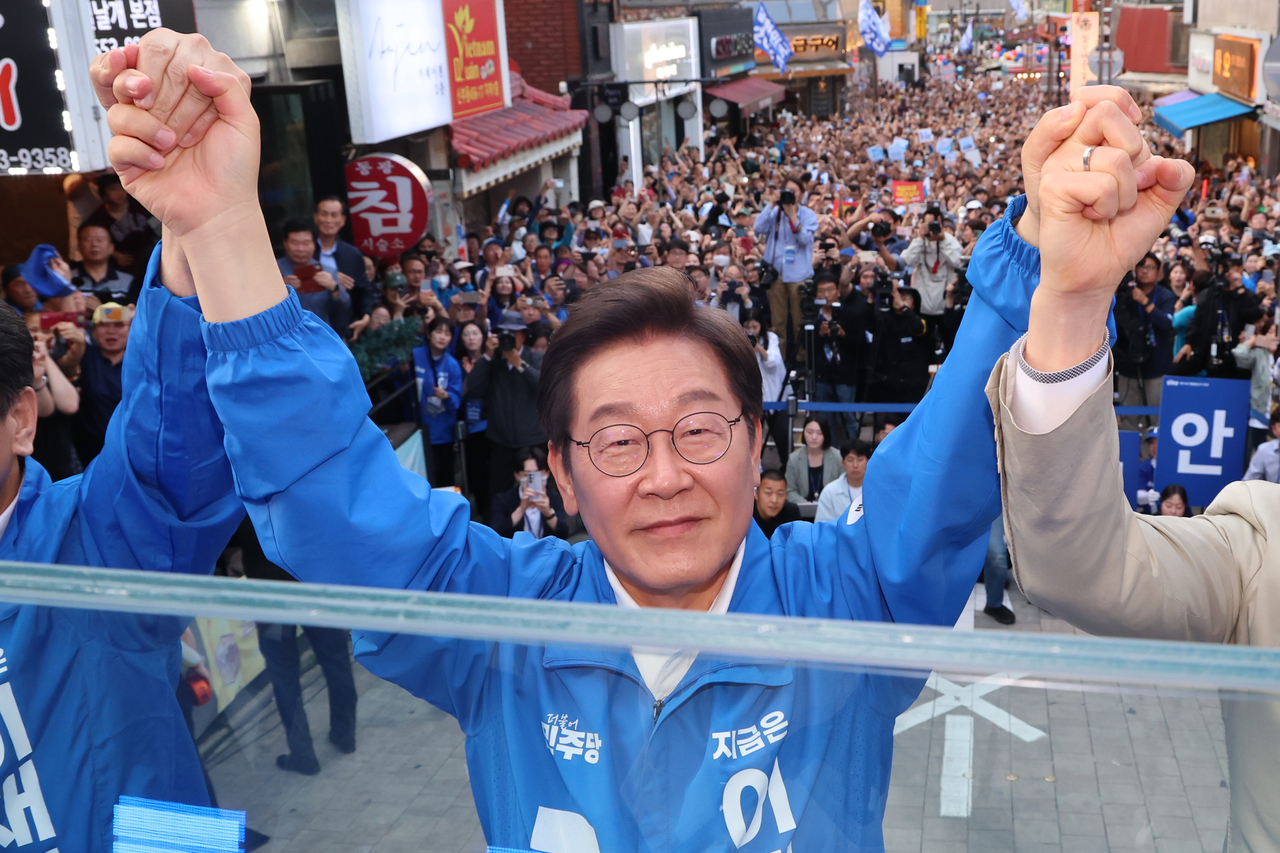
The Democratic Party of Korea's Lee Jae-myung presidential campaign on Monday held a meeting with OpenAI, the developer of the generative artificial intelligence service ChatGPT, to discuss cooperation in AI.
The Lee campaign and OpenAI officials, including Chief Strategy Officer Jason Kwon, met at a hotel in Seoul and talked about the AI company's expansion into the South Korean market as well as the Democratic Party candidate's AI policy vision.
Monday's meeting marks the first instance of an exchange with the industry outside South Korea for Lee, who has highlighted AI as one of the key industries to lead South Korea's economic growth.
With his plan, called "AI for all," Lee has vowed to make an AI service like ChatGPT that can be used by anyone free of charge. The idea is to come up with a quality AI service that is owned partly by the government so that it is accessible to all Koreans, he says.
Lee has pledged to inject some 100 trillion won ($73.46 billion) into the AI industry if he is elected, to turn South Korea into one of the "world's top three AI powerhouses."
In a Facebook post on May 17, Lee said he would "open up an era of 100 trillion-won AI investment and make South Korea a global hub for digital and AI innovation."
Lee said he would create sovereign funds to invest in AI companies, and distribute the profits to the people, while giving the companies tax benefits and further investment.
On March 2, Lee, then party leader, said he would help build a "South Korean equivalent" to Nvidia, a multinational chip company known for graphics processing units that are heavily used in AI.
Lee has proposed using the taxpayer-funded AI companies to partially realize a universal basic income, which he has championed since his days as the governor of Gyeonggi Province.
"Let's say a company like Nvidia were newly established. If the public owns a 30 percent stake and the other 70 percent is held by the private sector, then distributing that 30 percent share among all Koreans could lead to a society where we no longer need to rely on taxes," Lee said.
"The 'basic income' society I envision is one where the basic needs of the people are guaranteed by the community."
Nvidia made $72 billion in annual income in its last earnings report. If a similarly sized company shared 30 percent of its profits with Korean citizens, it would work out at about $430 each.
arin@heraldcorp.com



![[Graphic News] Average parental age of S. Koreans rises](https://wimg.heraldcorp.com/news/cms/2026/09/27/news-p.v1.20260927.0bcbf944ca9043c4a6ad4401fcfae25c_T1.gif?type=h&h=800)